
Thanksgiving Facts
Thanksgiving facts have a funny way of making American history sound like something invented by a particularly mischievous Hollywood screenwriter.
Consider this: Americans once celebrated Thanksgiving on two different Thursdays because the president wanted people to start Christmas shopping earlier. The first Macy’s Thanksgiving Day Parade featured live zoo animals. And the Pilgrims’ famous Thanksgiving dinner probably didn’t include pumpkin pie, mashed potatoes, or cranberry sauce.
That’s practically the entire modern menu gone before anybody says grace.
Then there are the turkeys. They can fly at highway speeds, sleep in trees, and make noises considerably more sophisticated than the occasional gobble. Benjamin Franklin even praised their character while criticizing the bald eagle.
Of course, Thanksgiving has never been merely about turkey and dressing. Its complicated history includes Native American traditions, colonial survival, presidential politics, retail promotions, football rivalries, and a few truly remarkable episodes of human behavior.
So loosen your belt and pull up a chair. We’ve gathered 75 strange, surprising, and occasionally hilarious Thanksgiving facts that sound completely made up.
But every one has a basis in documented history, science, or established tradition.
And unlike your uncle’s annual explanation of why his fantasy football team is actually better than its record, these stories come with evidence.
- The First Thanksgiving: 12 Facts That Rewrite the Story
- Thanksgiving Food Facts: 12 Culinary Surprises
- Thanksgiving History: 12 Presidential and Political Oddities
- Turkey Facts: 10 Reasons the Bird Is Stranger Than You Think
- Macy’s Thanksgiving Day Parade: 11 Facts That Belong in a Comedy Movie
- Thanksgiving Football: 8 Facts That Deserve Their Own Highlight Reel
- Thanksgiving’s Wildest Traditions: 10 More Facts That Sound Invented
- Final Thoughts: Thanksgiving Is Stranger Than We Remember
The First Thanksgiving: 12 Facts That Rewrite the Story
Forget the tidy textbook illustration of smiling Pilgrims and Native Americans gathered around a picturesque banquet table. The real story of the 1621 Plymouth harvest celebration was more interesting, more complicated, and considerably less predictable.
- The people at the first Thanksgiving didn’t call it Thanksgiving. The 1621 gathering at Plymouth was a harvest celebration, not an established annual holiday. Nobody attending knew that future Americans would spend centuries reenacting the occasion in elementary-school pageants. The event became widely associated with the “First Thanksgiving” much later, as Americans developed a national origin story for the holiday.
- Nobody knows the exact date of the famous 1621 celebration. Historians place the gathering sometime between September 21 and November 9, 1621. In other words, the original event might have happened while modern Americans were still buying Halloween candy. November’s fourth Thursday had nothing to do with the occasion.
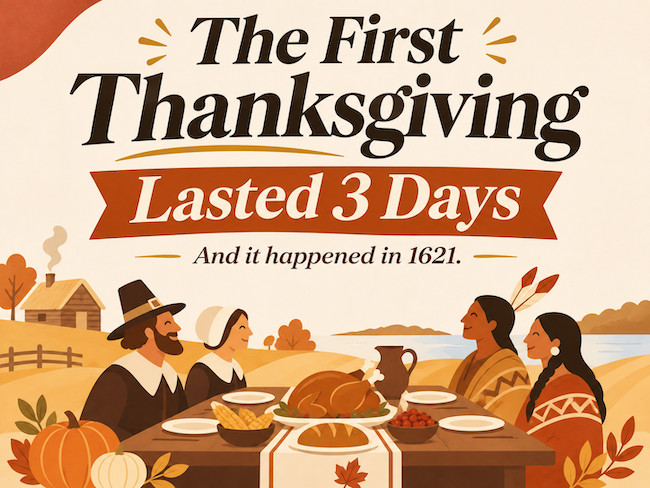
- The original Thanksgiving gathering lasted three days. According to the surviving account of English colonist Edward Winslow, the Wampanoag and English shared three days of feasting and activities. Imagine hosting Thanksgiving dinner, discovering everyone was staying through Saturday, and realizing you had no refrigerator, microwave, or food-delivery service.
Discover fun things to do when you’re really bored.
Numbers
- Native Americans outnumbered the English colonists by nearly two to one. Approximately 90 Wampanoag men attended, compared with about 50 surviving English colonists. This makes many traditional paintings of the event, with their enormous crowds of Pilgrims and handful of Native Americans, historically misleading.
- The Wampanoag leader known as Massasoit had another name. He was Ousamequin, an influential Wampanoag leader. Massasoit was a title associated with his position as a great sachem. He played a major role in diplomacy between the Wampanoag and English settlers, making his presence at the celebration politically significant.
- The Wampanoag brought five deer to the feast. The account specifically records that Wampanoag hunters presented five deer to the English leaders. Venison, therefore, has a much stronger claim to the original Thanksgiving menu than cranberry sauce or green bean casserole. The latter wouldn’t arrive for another three centuries.
Check out our fun Thanksgiving Jokes for Kids.
More Interesting Facts
- Four Englishmen went hunting for birds before the celebration. Winslow reported that the Plymouth governor sent four men to hunt wildfowl. They returned with enough birds to help feed the settlement for nearly a week. Unfortunately for modern Thanksgiving historians, he never wrote down precisely which birds they captured.
- The celebration included gunfire. The English colonists practiced firing their weapons during the harvest festivities. Some Wampanoag historical interpretations suggest the gunfire may have prompted Ousamequin and his men to investigate, although the precise circumstances of their arrival remain uncertain. Either way, this was hardly a quiet afternoon of pumpkin decorating.
- Only two surviving English accounts describe the 1621 gathering. Much of what we believe about the original celebration comes from brief writings by Edward Winslow and William Bradford. Neither left a detailed menu, seating chart, or minute-by-minute account. Historians have spent centuries reconstructing an event documented in surprisingly few words.
Explore our Fun Questions to Ask Folks feature.
The People
- Only four adult English women had survived to the time of the celebration. The colony’s devastating first winter had killed many of its inhabitants. By autumn 1621, only four adult English women remained: Elizabeth Hopkins, Elinor Billington, Mary Brewster, and Susanna Winslow. They probably helped supervise food preparation, with assistance from other members of the community.
- The English settled on land that had already been home to a Native American community. Plymouth was established at Patuxet, a Wampanoag village devastated by an epidemic before the Mayflower arrived. The site was not an empty wilderness awaiting discovery. It was part of an established Indigenous homeland whose people had experienced catastrophic losses.
- Native Americans practiced thanksgiving traditions long before 1621. Many Indigenous communities had longstanding ceremonies and customs expressing gratitude for harvests, animals, natural resources, and relationships. The idea of giving thanks was hardly introduced to North America by European settlers. What developed later was a particular American national holiday with its own evolving traditions.
Historical sources: Plimoth Patuxet Museums, Smithsonian National Museum of the American Indian, and Pilgrim Hall Museum.
Thanksgiving Food Facts: 12 Culinary Surprises
Our ancestors would hardly recognize a modern Thanksgiving table. The dishes we now consider essential developed over generations, helped along by changing agriculture, cooking technology, and the occasional food-company marketing department.
- There’s no definitive proof that turkey was served at the original feast. The eyewitness account mentions wildfowl but doesn’t identify the species. Wild turkeys were present in the region, so turkey remains entirely possible. But historians can’t confirm that one appeared on the table. The bird that became Thanksgiving’s official mascot doesn’t have an airtight alibi for being there.
- Ducks and geese may have been bigger stars than turkey. Migratory waterfowl were abundant around Plymouth in autumn. Historians consider ducks and geese plausible candidates for the birds hunted before the feast. Unfortunately, the surviving records aren’t specific enough to settle the matter.
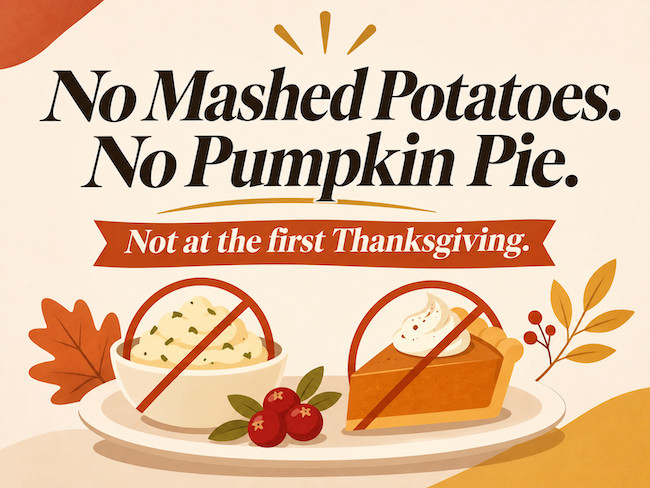
- There were no mashed potatoes at the original Thanksgiving. Neither white potatoes nor sweet potatoes were part of the documented Plymouth harvest menu. White potatoes originated in South America and had not yet become established in English North American colonial cooking. Those mountains of buttery mashed potatoes arrived much later.
Pumpkins & Pies – Thanksgiving Facts
- Pumpkin pie was essentially impossible. Pumpkin was available, but the colonists lacked the usual ingredients and equipment required for the familiar dessert. Butter and wheat flour were scarce, and the settlement did not have the kind of baking facilities needed to prepare conventional pies. Imagine Thanksgiving without dessert. Civilization had some catching up to do.
- Actual pumpkins probably appeared in some form. Pumpkins and other squashes were indigenous to North America and familiar to the Wampanoag. Historians consider their presence at the harvest celebration likely, although the exact preparations are unknown. Roasted or cooked pumpkin would have been perfectly reasonable. Whipped cream and decorative pastry leaves were another matter.
- Apple pie wasn’t part of the original celebration, either. Europeans had not yet established the apple orchards that would eventually flourish in colonial New England. The Plymouth settlers therefore lacked the apples needed to make the familiar dessert. America’s most celebrated pie was not yet ready for its American close-up.
The Fixings – Thanksgiving Facts
- Sweet cranberry sauce was missing from the table. Cranberries grew in the region, and Native communities were familiar with them. However, the sweetened sauce Americans know today was a later development. There is no evidence it appeared at the 1621 gathering. The tart berries themselves may have been available, but that’s different from serving a shimmering bowl of cranberry jelly.
- Canned cranberry sauce was introduced in 1912. Cranberry grower Marcus Urann pioneered commercial cranberry canning in 1912, helping turn a seasonal fruit into a year-round product. Eventually, the familiar cylindrical serving of jellied sauce became a Thanksgiving staple. Few foods can emerge from a can wearing the exact shape of their packaging and still inspire such fierce family loyalty.
- Corn was far more important than most modern Thanksgiving side dishes. Indigenous maize was essential to the Plymouth settlement’s food supply. Colonists ground it into meal that could be prepared as porridge or bread. It wasn’t glamorous, but surviving in New England depended considerably more on corn than on deciding whether stuffing should contain sausage.
- The colonists lived near an enormous seafood pantry. Shellfish and fish were plentiful around coastal New England. Mussels, clams, and other seafood were familiar foods in the region. They could have appeared during the 1621 celebration, but historians cannot confirm a seafood course. It’s an intriguing possibility, not a documented appetizer list.
Take the Fun Trivia Questions Challenge and see how you stack up.
Utensils – Thanksgiving Facts
- The English colonists ate without forks. Knives, spoons, and fingers did much of the work. Forks had not yet become common table utensils among the Plymouth settlers. Modern Thanksgiving hosts who worry about matching silverware might appreciate a holiday where the utensil requirements were substantially simpler.
- The napkins could be three feet square. Large linen napkins helped diners manage food served and eaten partly by hand. Some period table linens were approximately three feet across. That’s practically a small tablecloth by modern standards—and probably useful when eating roast meat without a fork.
Food-history sources: Plimoth Patuxet’s reconstruction of the 1621 menu and Smithsonian Magazine’s history of canned cranberry sauce.
Thanksgiving History: 12 Presidential and Political Oddities
You might assume Thanksgiving became a national holiday because everyone liked gathering around a table to express gratitude.
That was certainly part of it.
But the holiday’s official history also involves a determined magazine editor, a Civil War president, an economic experiment, and a disagreement that temporarily gave Americans two different Thanksgiving dates.
- George Washington declared a Thanksgiving in 1789. On October 3, 1789, Washington proclaimed November 26 a day of public thanksgiving and prayer. This was the first Thanksgiving proclamation issued under the newly established United States Constitution. The nation’s original presidential Thanksgiving therefore predates Abraham Lincoln’s more famous proclamation by nearly three-quarters of a century.
- Congress actually helped launch Washington’s Thanksgiving. The First Federal Congress requested that the president recommend a day of national thanksgiving. Washington responded with his proclamation. It was an early example of the legislative and executive branches cooperating on something that didn’t require months of negotiations over spending.
- Thanksgiving didn’t always fall in November. Early presidential proclamations selected different dates, sometimes in different months. Thanksgiving existed in various forms for generations before Americans settled on a recurring national calendar tradition. For much of the country’s early history, the holiday was considerably less predictable than your relatives’ political opinions.
- Abraham Lincoln promoted a national Thanksgiving during the Civil War. In October 1863, with the country torn apart by war, Lincoln called for a nationwide Thanksgiving observance. His proclamation emphasized gratitude and healing during a period of extraordinary suffering. The modern annual tradition owes much to that decision.
The Holiday – Thanksgiving Facts
- A magazine editor spent 17 years campaigning for Thanksgiving. Sarah Josepha Hale began an organized campaign for a unified national Thanksgiving in 1846. She wrote editorials, encouraged public support, and contacted political leaders. Her persistence helped bring about Lincoln’s 1863 proclamation. If she had possessed an email account, American presidents might have needed a special spam filter.
- The woman who helped establish Thanksgiving also wrote: “Mary Had a Little Lamb.”Yes, really. Sarah Josepha Hale is credited with the famous nursery rhyme, originally published as a poem in 1830. Her contributions to American culture ranged from an enduring children’s verse to the campaign for one of the nation’s most important holidays. That’s a rather impressive résumé.
- Thanksgiving’s biggest early promoter was a publishing powerhouse. Hale edited Godey’s Lady’s Book, one of the influential American magazines of the nineteenth century. She used the publication to champion Thanksgiving traditions, recipes, and national unity. In today’s language, she understood the power of content marketing long before anyone invented the phrase.
- Lincoln originally designated the last Thursday of November, not the fourth. Those sound identical until November has five Thursdays. Lincoln’s proclamation established the last Thursday as the recurring observance, whereas today’s federal law specifies the fourth Thursday. The distinction eventually became important enough to require congressional action.
Making It Official – Thanksgiving Facts
- Thanksgiving became a federal holiday in 1870. Seven years after Lincoln’s proclamation, Congress included Thanksgiving among the holidays legally recognized for federal workers in Washington, D.C. Its date still depended on presidential proclamation. The modern fixed-date system came decades later.
- Franklin D. Roosevelt moved Thanksgiving to encourage Christmas shopping. In 1939, Roosevelt shifted the observance earlier because retailers were concerned about the short shopping season between Thanksgiving and Christmas. The country was still recovering from the Great Depression, and the administration hoped the change would help businesses. American holiday shopping madness has surprisingly deep roots.
- Some Americans celebrated two different Thanksgivings. Roosevelt’s decision proved so controversial that states disagreed about which Thursday to recognize. According to the National Archives, 32 states followed the president’s earlier date while 16 initially retained the traditional later date. Critics jokingly called the new observance “Franksgiving.” Families in different states could be carving turkeys a week apart.
- The fourth-Thursday rule became law the day after Christmas in 1941. On December 26, 1941, Roosevelt signed legislation fixing Thanksgiving on November’s fourth Thursday. After years of confusion, the calendar finally achieved some consistency. The law remains the foundation of the holiday’s modern date.
Historical sources: National Archives, Library of Congress, and National Park Service biography of Sarah Josepha Hale.
Turkey Facts: 10 Reasons the Bird Is Stranger Than You Think
The turkey has suffered one of history’s great public-relations disasters.
Americans have spent generations portraying it as a slow, awkward, mildly confused creature whose greatest contribution to civilization is gravy.
The wild turkey deserves a little more respect.
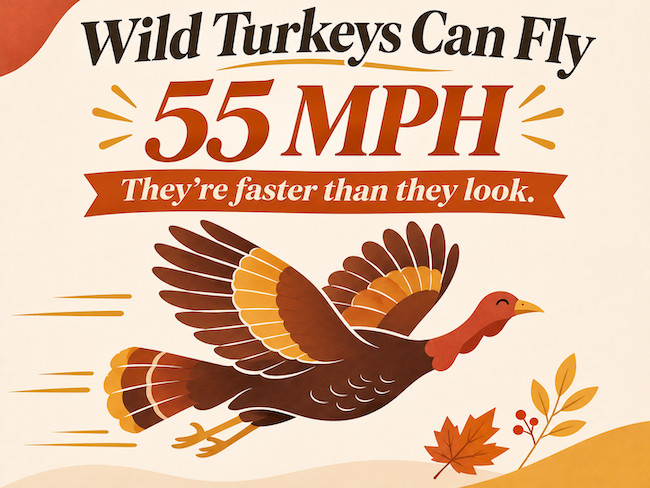
- Wild turkeys can fly approximately 55 miles per hour. Unlike many domesticated birds raised for meat, wild turkeys are powerful short-distance fliers. They can reach speeds comparable to cars traveling on a highway. The average Thanksgiving turkey could never manage that performance, but its wild relatives are remarkably athletic.
- Wild turkeys can run about 18 miles per hour. That’s faster than most humans can sprint for any meaningful distance. A healthy wild turkey could probably outrun a substantial portion of the guests at your Thanksgiving gathering, particularly after the second helping of mashed potatoes.
- Wild turkeys sleep in trees. Despite spending much of their waking time on the ground, wild turkeys fly into trees to roost at night. Elevated sleeping locations help protect them from predators. Imagine looking up into a tree and discovering several Thanksgiving centerpieces perched above your head.
- Wild turkeys can swim. The Smithsonian’s National Zoo confirms that wild turkeys are capable swimmers. Although they spend most of their lives walking or making brief flights, water isn’t necessarily an insurmountable obstacle. Flying, running, swimming—this bird has apparently been hiding an impressive athletic résumé.
Oddities – Thanksgiving Facts
- Baby turkeys eat insects like candy. Young turkeys, called poults, depend heavily on insects during their earliest weeks. As they mature, their diets gradually include more plant material. Their menu changes dramatically with age, from protein-packed insects to seeds, nuts, berries, and other natural foods.
- Female turkeys sometimes lay eggs in another turkey’s nest. Scientists call this behavior brood parasitism or egg dumping. A female may deposit eggs in another female’s nest, leaving the recipient to incubate them. Evidently, some turkeys have discovered the advantages of outsourcing childcare.
- Turkeys make far more sounds than gobbling. Wild turkeys communicate through clucks, purrs, yelps, cackles, and other vocalizations. Gobbling is simply the best-known entry in their repertoire. A group of turkeys can produce a surprisingly complicated soundtrack without a single musical instrument.
- A turkey’s “beard” is actually made of feathers. The dark, bristly tuft protruding from many male turkeys’ chests looks like hair, but it consists of modified feathers. Most mature males develop beards, although some females have them, too. Nature evidently decided that a bird with a fleshy neck ornament also needed unusual facial-hair styling—located on its chest.
Colorful Past – Thanksgiving Facts
- Turkeys were domesticated in Mexico more than 2,000 years ago. The bird’s relationship with people began long before the Plymouth settlement. Indigenous peoples in ancient Mexico domesticated turkeys, which later became an important source of food and materials. The turkey’s history as a domestic animal is substantially older than the United States itself.
- A turkey’s head can change color. The bare skin on a male turkey’s head and neck may change shades of red, white, and blue in connection with excitement, courtship, and other physiological changes. It sounds like patriotic special effects, but it’s biology. The bird can practically decorate itself for an American holiday.
Wildlife sources: U.S. Fish and Wildlife Service and Smithsonian’s National Zoo.
Macy’s Thanksgiving Day Parade: 11 Facts That Belong in a Comedy Movie
What could be more wholesome than giant cartoon balloons drifting down Manhattan streets while marching bands perform and millions of Americans eat breakfast in their pajamas?
The parade’s history, however, is occasionally downright bizarre.
- Macy’s didn’t invent the Thanksgiving Day parade. Philadelphia’s Gimbels department store organized a Thanksgiving parade in 1920, four years before Macy’s launched its famous New York event. The Philadelphia procession is widely recognized as America’s oldest organized Thanksgiving Day parade. Macy’s eventually became the celebrity, but Philadelphia got there first.
- The original Macy’s parade was a Christmas promotion. When Macy’s launched its event on November 27, 1924, it was known as the Macy’s Christmas Parade. Its primary purpose was to celebrate the approaching Christmas shopping season. Thanksgiving was the convenient opening act. Retailers have been thinking about Christmas in November for a very long time.
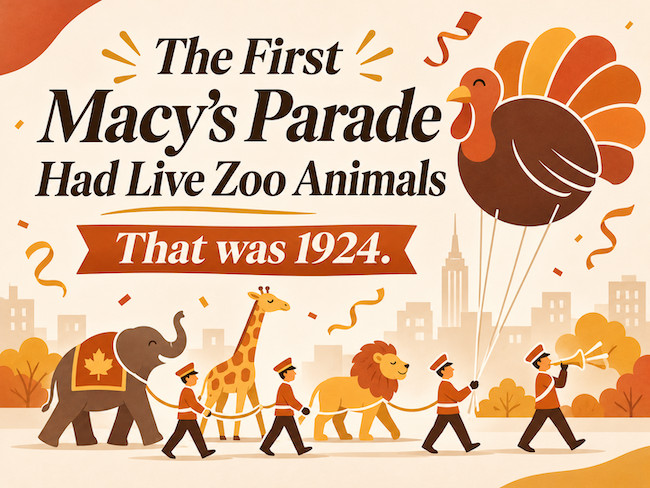
- The first Macy’s parade featured live zoo animals. Animals borrowed from the Central Park Zoo appeared alongside floats, costumed performers, and marching bands. Imagine standing on a New York sidewalk waiting for Santa Claus and suddenly seeing an elephant approaching. The modern balloon parade seems almost restrained by comparison.
The Balloons – Thanksgiving Facts
- Felix the Cat became a pioneering parade-balloon celebrity in 1927. Giant character balloons entered the parade in 1927, with Felix the Cat becoming its first major balloon character. Long before television turned cartoon mascots into corporate empires, a giant floating cat was attracting attention over Manhattan.
- Parade organizers once released giant balloons into the sky. Early balloons were sometimes simply let go at the end of the procession. The idea of sending enormous floating cartoon characters into the atmosphere apparently didn’t seem particularly alarming at the time. Some burst or disappeared. Others traveled surprisingly far.
- Macy’s offered rewards for returning escaped balloons. Beginning in 1928, balloons were fitted with valves to release helium gradually and carried return information. Anyone recovering a balloon could potentially earn a reward. Imagine opening your front door to find a gigantic cartoon animal deflating across your lawn. Congratulations, you’ve found a holiday souvenir.
- An escaped parade balloon nearly caused an aviation disaster. In 1932, a runaway balloon became entangled with an airplane’s wing, causing the aircraft to enter a tailspin before the pilot recovered. The incident helped end the practice of intentionally releasing balloons. It remains one of history’s more extraordinary examples of why holiday decorations and aircraft should maintain a respectful distance.
- Mickey Mouse made his parade debut in 1934. Disney’s famous character appeared as a balloon just six years after his 1928 screen debut. By the mid-1930s, Mickey had become a major cultural figure, and floating above Manhattan was another milestone in his rapidly expanding entertainment career.
Stoppage, TV, and Snoopy – Thanksgiving Facts
- World War II stopped the parade for three years. Macy’s suspended the event from 1942 through 1944, when rubber and helium were needed for the war effort. Materials from parade balloons were contributed to wartime needs. The balloons were literally sacrificed for a more important cause.
- The parade became a nationally televised event in 1947. Television transformed the parade from a New York spectacle into a shared American holiday tradition. Instead of traveling to Manhattan, families could watch from their living rooms. It also gave parents an excellent way to entertain children while preparing Thanksgiving dinner.
- Snoopy has been the parade’s most frequently reinvented balloon character. Charlie Brown’s beloved beagle has appeared in numerous balloon designs over the decades, more than any other parade character according to the Library of Congress. Whether flying as an aviator or appearing in other costumes, Snoopy keeps returning to the skies. Good grief, that’s staying power.
Parade sources: Library of Congress parade history and Library of Congress holiday parade research.
Thanksgiving Football: 8 Facts That Deserve Their Own Highlight Reel
For millions of Americans, Thanksgiving means turkey, football, and somebody yelling at the television.
But the connection between football and Thanksgiving is much older than the Super Bowl, the Dallas Cowboys, or the Detroit Lions’ annual appearance.
- College football was played on Thanksgiving in 1876. Yale defeated Princeton in a Thanksgiving game played in Hoboken, New Jersey. The contest looked more like rugby than modern football, and neither team had an official coach. Nevertheless, the holiday’s association with college football began nearly 150 years ago.
- The NFL played Thanksgiving games in its very first season. In 1920, the league’s inaugural season included Thanksgiving games. Among them, the Akron Pros defeated the Canton Bulldogs 7–0. Yes, there were once NFL teams called the Akron Pros and Canton Bulldogs. Professional football has always been excellent at producing memorable names.
- The Detroit Lions’ Thanksgiving tradition began as a marketing stunt. In 1934, Lions owner George A. Richards scheduled a holiday game against the powerful Chicago Bears to attract attention to his relatively new Detroit franchise. The game sold out, attracting approximately 26,000 spectators. Chicago won 19–16, but Detroit gained something almost as valuable: an enduring national tradition.
- The first Lions Thanksgiving game was broadcast on 94 radio stations. Richards had a background in radio and helped arrange an extensive national broadcast through NBC’s network. The exposure was enormous for professional football at the time. Long before streaming services and television rights worth billions, a smart radio promotion helped establish the holiday as football territory.
The Teams – Thanksgiving Facts
- The Lions’ Thanksgiving tradition actually took a six-season break. Detroit did not host its annual holiday game from 1939 through 1944. The interruption coincided with the years surrounding World War II and wartime changes to the league. The annual tradition resumed in 1945 and has continued since.
- The Dallas Cowboys didn’t join the Thanksgiving party until 1966. More than three decades after Detroit began playing on the holiday, Dallas established its own Thanksgiving tradition. The Cowboys’ national popularity helped transform holiday football into an even bigger television event. The Lions and Cowboys eventually became the holiday’s two most recognizable NFL hosts.
- The NFL didn’t introduce a regular third Thanksgiving game until 2006. For decades, fans typically watched the Detroit and Dallas games. In 2006, the NFL added a third Thanksgiving contest in prime time, expanding the holiday’s football schedule. Suddenly, the traditional post-dinner nap had competition from another nationally televised game.
- One of football’s most famous Thanksgiving mistakes happened in the snow—in Texas. In 1993, Dallas defensive lineman Leon Lett attempted to recover a blocked Miami Dolphins field goal in snowy conditions. His touch made the ball live, allowing Miami to recover it and kick the winning field goal. The Dolphins won 16–14. Lett’s disastrous slide remains a Thanksgiving football classic, proving that sometimes the best play is not touching the football.
Football sources: Pro Football Hall of Fame, National Football Foundation, and NFL Thanksgiving history.
Thanksgiving’s Wildest Traditions: 10 More Facts That Sound Invented
Still have room for a few more?
Excellent. We’ve saved some of the strangest Thanksgiving stories for last, including a presidential pardon that didn’t happen, a holiday celebrated in space, and a casserole invented in a corporate test kitchen.
- The modern presidential turkey pardon began in 1989. President George H. W. Bush formally pardoned a turkey during a White House ceremony, establishing the modern annual tradition. Previous presidents had occasionally spared turkeys, but Bush made the official pardon a recurring event. It’s probably the only time most Americans enthusiastically follow a presidential clemency announcement involving poultry.
- Harry Truman probably never pardoned a Thanksgiving turkey. Truman is frequently credited with starting the custom in 1947, but the Truman Presidential Library found no contemporary evidence supporting that story. He received turkeys as gifts, but receiving one and pardoning one are very different things. Some presidential birds reportedly had considerably less optimistic dinner plans.
- John F. Kennedy spared a turkey in 1963 without issuing a formal pardon. Kennedy decided not to eat a turkey presented to him shortly before his assassination. Instead, he sent it back, allowing the bird to live. His informal act of mercy preceded the official pardon tradition by more than two decades.
Others’ Views – Thanksgiving Facts
- Some Native Americans observe Thanksgiving as a National Day of Mourning. Since 1970, Indigenous activists and supporters have gathered in Plymouth, Massachusetts, for a National Day of Mourning. The observance recognizes the devastating consequences of European colonization and challenges simplified portrayals of the first Thanksgiving. It’s an important reminder that American history can be understood very differently by the people who experienced its consequences.
- Canada celebrates Thanksgiving in October. Since 1957, Canadian Thanksgiving has fallen on the second Monday in October. The earlier date corresponds more closely with the harvest season in much of Canada. Americans and Canadians therefore celebrate similar holidays roughly six weeks apart, each presumably convinced their timing makes perfect sense.
- Japan has a holiday called Labor Thanksgiving Day. Celebrated on November 23, Japan’s Labor Thanksgiving Day honors work, productivity, and mutual gratitude among citizens. It is not the same holiday as American Thanksgiving, but the shared emphasis on appreciation makes the connection interesting. Turkey and pumpkin pie are not required.
- The first Thanksgiving celebrated in space happened in 1973. Astronauts Gerald Carr, Edward Gibson, and William Pogue marked Thanksgiving aboard the Skylab space station on November 22, 1973. Their celebration was considerably different from anything happening in American dining rooms. For starters, there was the minor complication of orbiting Earth.
Astronauts and Green Bean Casserole – Thanksgiving Facts
- Those first Thanksgiving astronauts didn’t enjoy a traditional turkey dinner. Two crew members completed a spacewalk lasting more than six hours, while their colleague also missed lunch. The astronauts eventually ate two meals at dinnertime, but neither featured special Thanksgiving foods. Imagine working through Thanksgiving, going hungry most of the day, and discovering the menu didn’t even include stuffing.
- Astronauts eventually celebrated Thanksgiving with turkey, cranberry sauce, and shrimp cocktail. In 1985, the crew of space shuttle Atlantis enjoyed a more festive orbital meal featuring those dishes. The mission also included Mexican astronaut Rodolfo Neri Vela, who helped introduce tortillas to space menus. Tortillas became popular because they don’t produce the floating crumbs that make ordinary bread troublesome in weightlessness.
- Green bean casserole was invented in a corporate test kitchen. Dorcas Reilly developed the dish at Campbell’s in 1955, using ingredients that included canned green beans and cream of mushroom soup. Originally called Green Bean Bake, it became a Thanksgiving institution after the company promoted the recipe. One of America’s most recognizable holiday traditions was essentially a successful product-development project. Somewhere, a marketing executive deserves a second helping.
Additional sources: National Turkey Federation, Truman Presidential Library, NASA’s Thanksgiving celebrations in space, and National Inventors Hall of Fame.
Final Thoughts: Thanksgiving Is Stranger Than We Remember
Thanksgiving may be one of America’s most familiar holidays, but familiarity has a way of disguising just how unusual its history really is.
The original Plymouth celebration wasn’t a carefully scripted national origin story. It was a gathering involving two communities with complicated relationships, uncertain expectations, and very different experiences.
The holiday we celebrate today emerged much later, shaped by changing traditions, magazine editors, presidential proclamations, food companies, football teams, department stores, and generations of families.
Along the way, Americans invented a few customs that would sound ridiculous without the benefit of tradition.
We gather around enormous roasted birds. We eat bread that’s been cooked inside other food. And we watch gigantic cartoon animals float above city streets. We devote entire afternoons to watching grown men collide on football fields.
And when dinner ends, we solemnly explain that we’re far too full to eat another bite.
Then someone brings out the pie.
What Surprised You?
Which of these 75 Thanksgiving facts surprised you most? Share your favorite at the table this year. It’s an excellent way to start a conversation, impress a relative, or distract everyone from another argument about whether the stuffing should contain raisins.
Happy Thanksgiving—and may your turkey be delicious, your relatives reasonably well-behaved, and your historical facts considerably more accurate than the average elementary-school pageant.

By M.L. O’Halloran
Founder and Editor, ListCaboodle
Mike O’Halloran founded ListCaboodle in 2017. He has authored four joke books, three books on basketball coaching, and co-authored four books on kids’ trivia.
His other websites include Sports Feel Good Stories and Greeting Card Poet.
He is the publisher of the Well-Prepared Coach line of coaches’ practice plans, off-season training guides for young athletes, and editable award certificates. The certificate line covers more than 15 sports, including baseball, basketball, football, hockey, golf, softball, tennis, and more.
Mike is married with four children.
You are on our 75 Thanksgiving Facts That Sound Fake (But Are True!) feature.
You might also like:
