
True Facts That Sound Fake
Reality has a credibility problem. There are some things that sound fake, that arent’.
Wombats poop cubes. Bananas are berries, but strawberries aren’t. Sharks were swimming around before trees existed. Nintendo was founded in the 1800s. And on Venus, completing one rotation takes longer than completing an entire trip around the Sun.
If somebody casually mentioned any of those at dinner, you’d be justified in saying, “That can’t possibly be true.”
And yet it is.
The world is stuffed with things that sound fake but are actually true, from bizarre animal abilities and strange quirks of the human body to historical coincidences that make the timeline of civilization feel completely broken.
Some unbelievable facts spread online because they’re fascinating. Unfortunately, others spread because nobody bothered checking them.
So this collection takes the harder route: 100 strange, surprising, funny, and genuinely interesting facts, with enough explanation to show why each one deserves a place on the list.
Prepare to distrust common sense.
- Weird Animal Facts That Sound Fake But Are True
- Human Body Facts That Don’t Seem Possible
- Food Facts That Sound Completely Wrong
- Earth and Weather Facts That Seem Fake
- Space Facts That Sound Like Science Fiction
- Historical Facts That Make Time Feel Broken
- Language Facts That Sound Invented
- Technology Facts That Sound Made Up
- Math and Everyday Science Things That Sound Fake
- Plant, Nature and Miscellaneous Facts That Sound Fake
- How to Check Whether an Unbelievable Fact Is Actually True
- FAQ About Things That Sound Fake But Are Actually True
- A Note About Accuracy
- Final Thoughts: The Truth Has an Excellent Sense of Humor
Weird Animal Facts That Sound Fake But Are True
Nature clearly wasn’t worried about whether its creations would sound believable.
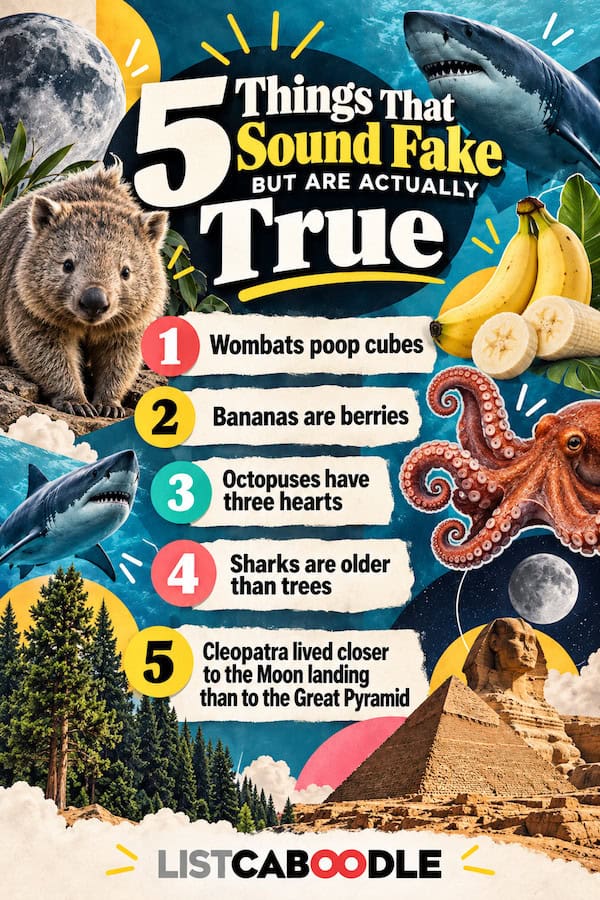
1. Wombats poop cubes
Yes, actual cubes.
Bare-nosed wombats produce unusually cube-shaped droppings. Research suggests the shape develops because different portions of the wombat’s intestine stretch and contract at different rates as the feces move through it.
Why cubes?
One benefit is that the droppings don’t roll away easily, which is convenient because wombats use them for scent marking.
Some animals mark their territory.
Wombats apparently prefer building materials.
2. Octopuses have three hearts
One heart wasn’t enough for the octopus.
Two branchial hearts pump blood through the gills, while a third systemic heart circulates oxygenated blood through the rest of the animal’s body.
Octopus blood is also blue.
Instead of the iron-containing hemoglobin humans use to transport oxygen, octopuses rely on copper-containing hemocyanin, which gives their blood its bluish appearance.
Three hearts, blue blood and eight arms.
The octopus was apparently designed by a committee that refused to reject any ideas.
3. Sharks existed before trees
The evolutionary history of sharks stretches back more than 400 million years.
The first true trees appeared later.
That means shark ancestors were cruising Earth’s oceans before forests resembling anything we’d recognize had developed on land.
They survived enormous environmental changes and multiple mass-extinction events.
The next time a shark looks prehistoric, give it credit.
It has seniority.
4. Humans and giraffes usually have the same number of neck vertebrae
Your neck and a giraffe’s neck look as if they should have very little in common.
Yet both normally contain seven cervical vertebrae.
The difference is size.
A giraffe’s individual neck bones are enormously elongated compared with ours.
Evolution apparently saw no reason to add more pieces when supersizing seven would do the job.
5. Butterflies can taste with their feet
Butterflies possess chemical receptors on their legs and feet that help them evaluate the plants they land on.
Female butterflies can use those receptors when deciding whether a plant is suitable for laying eggs.
Humans examine a restaurant menu.
Butterflies step on it.
6. Dolphins can sleep with half of their brain at a time
Dolphins must consciously surface to breathe.
Going completely unconscious for eight hours would therefore create a fairly significant problem.
Their solution is unihemispheric sleep.
One cerebral hemisphere can enter a sleep state while the other remains sufficiently alert to control breathing and monitor the surroundings.
Anyone who has attended a Monday morning staff meeting may feel they’ve attempted something similar.
7. Flamingos aren’t born pink
Baby flamingos generally hatch with grayish or whitish feathers.
Their famous pink coloring develops because of carotenoid pigments obtained from foods such as algae and small aquatic organisms.
No special diet, no signature pink.
Even flamingos have to earn the wardrobe.
8. Koalas have fingerprints remarkably similar to ours
Koalas have fingerprints containing loops, whorls, and ridges that can look strikingly similar to human fingerprints.
What’s especially interesting is that humans and koalas aren’t closely related.
Their fingerprint patterns evolved independently.
Apparently, eucalyptus consumption and excellent grip eventually led to fingerprints.
9. Male seahorses give birth
Female seahorses deposit eggs into a specialized brood pouch on the male.
The male fertilizes the eggs and carries the developing young until they are ready to emerge.
He then undergoes muscular contractions and releases the babies.
So yes: in seahorses, Dad handles the pregnancy.
Mother’s Day still has better marketing.
10. Crows can remember human faces
Research has shown that crows can distinguish between human faces and remember people they associate with danger.
That memory can last for years.
Other crows may also learn which humans are threatening through social interactions.
So if you’ve ever thought, “It’s just a bird. It’ll forget about this,” you may want to verify that the bird isn’t a crow.
Explore our funny Animal Jokes for Kids feature.
Human Body Facts That Don’t Seem Possible
You have been living inside the human body your entire life.
It has apparently withheld quite a bit of information.
11. Babies are born with more bones than adults have
A newborn typically has around 270 bones, while the standard count for an adult skeleton is about 206.
Nobody is gradually losing dozens of bones under the couch.
Many bones fuse as a child grows.
Parts of the skull, spine and pelvis are among the areas where this consolidation occurs.
Growing up apparently involves some assembly.
12. You’re slightly taller in the morning
The discs between the vertebrae of your spine contain fluid and are compressed when you’re upright.
After hours of standing and sitting, your spine becomes slightly compressed.
During sleep, when your body is horizontal and the gravitational load changes, the discs recover some of their height.
Consequently, you’re usually a little taller shortly after getting out of bed than you are before going to sleep.
Enjoy it.
It’s all downhill from breakfast.
13. The smallest bone in your body is in your ear
The stapes, located in the middle ear, is the smallest bone in the human body.
It measures only a few millimeters.
Along with the malleus and incus, it helps transmit vibrations involved in hearing.
A tiny bone with an extremely important assignment.
Corporate America would call that a lean department.
14. Your femur is the longest bone in your body
The femur runs from your hip to your knee.
It is the longest bone in the human skeleton and is also built to withstand substantial forces.
That’s helpful considering one of its everyday responsibilities is supporting your weight while you walk, stand, run, and occasionally trip over something you absolutely knew was there.
15. Your cornea has no blood vessels
The cornea is the transparent tissue covering the front of the eye.
Unlike most tissues, a healthy cornea contains no blood vessels.
Instead, it receives oxygen and nutrients through tears, the atmosphere and fluids inside the eye.
Blood vessels would interfere with transparency.
Your eye, quite sensibly, doesn’t put plumbing through the window.
16. Your liver can regenerate
The human liver has a remarkable capacity to restore lost tissue.
If part of a healthy liver is surgically removed, the remaining tissue can enlarge and restore much of the organ’s functional mass.
This doesn’t mean a person can repeatedly remove pieces and grow an unlimited number of replacement livers.
But among major human organs, the liver’s regenerative capabilities are extraordinary.
17. Your brain consumes about 20% of your body’s resting energy
The adult brain accounts for only a small percentage of total body weight.
Yet it consumes roughly one-fifth of the body’s energy at rest.
Maintaining electrical activity, signaling between neurons, and keeping brain cells functioning is expensive work.
Thinking really does burn energy.
Unfortunately, staring at a crossword puzzle still isn’t cardio.
18. Goosebumps are a leftover from hairier ancestors
Tiny muscles attached to your hair follicles contract when you’re cold or frightened.
That produces goosebumps and makes the hairs stand up.
For furry mammals, raised hair can trap insulating air or make the animal appear larger to a threat.
Humans retained the mechanism while losing most of the dramatic visual effect.
We’re essentially performing an ancient intimidation display with very little fur to back it up.
19. Many taste receptor cells are replaced every week or two
Taste cells aren’t permanent fixtures.
Many have relatively short lifespans and are regularly replaced by new cells.
That doesn’t mean every taste bud vanishes at once. A taste bud contains multiple cells at different stages of life.
Your mouth is constantly doing renovations without closing the restaurant.
20. Your stomach has to protect itself from its own contents
Stomach acid helps break down food and provides an inhospitable environment for many microbes.
Unfortunately, the stomach itself is also made of biological tissue.
A protective mucus layer, bicarbonate, tightly connected cells, and rapid tissue repair help protect the stomach lining from its harsh internal environment.
Your stomach essentially maintains an aggressive chemical environment and then spends considerable effort to satisfy its own safety regulations.
Learn more about the body through our interesting Fitness Quotes article.
Food Facts That Sound Completely Wrong
Few things destroy confidence in everyday language faster than asking a botanist what counts as a berry.
21. Bananas are berries
Botanically, bananas qualify as berries.
A botanical berry develops from a single flower with a single ovary and has seeds—or remnants of seeds—embedded within its fleshy interior.
Bananas fit the definition.
Your smoothie has apparently been scientifically accurate all along.
22. Strawberries aren’t true botanical berries
This is where botany begins behaving badly.
The red fleshy portion of a strawberry isn’t technically the fruit in the ordinary botanical sense.
Those tiny things that look like seeds on the outside are individual fruits called achenes, each usually containing a seed.
So bananas are berries.
Strawberries aren’t.
Please direct complaints to the plant kingdom.
23. Peanuts aren’t nuts
Peanuts are legumes.
That puts them in the same plant family as beans, lentils and peas rather than true tree nuts such as walnuts.
Peanut plants also develop their pods underground.
The peanut has been living under an assumed identity and literally keeping a low profile.
24. Cashews grow attached to the bottom of a fruit
Cashews don’t develop inside a shell buried within a conventional fruit.
The cashew seed develops in a kidney-shaped structure attached beneath a fleshy stalk commonly called a cashew apple.
Seeing cashews growing naturally can make the packaged version at the grocery store suddenly seem very strange.
Nature’s original packaging department was feeling experimental that day.
25. Vanilla comes from an orchid
Natural Vanilla is produced from the seed pods of orchids belonging to the genus Vanilla.
The familiar flavor requires an elaborate process of growing, pollinating, harvesting, and curing the pods.
So the word we use to mean “plain” comes from a tropical orchid requiring substantial effort to produce.
Vanilla deserves an apology.
26. White chocolate contains cocoa butter but no cocoa solids
Regular dark and milk chocolates contain nonfat cocoa solids, which provide much of chocolate’s familiar brown color and flavor.
White chocolate contains cocoa butter but lacks those cocoa solids.
That’s why it looks and tastes so different.
Whether people wish to argue over whether it is “real chocolate” is up to them.
Family gatherings need something to discuss.
27. Honey naturally resists spoilage remarkably well
Honey has a low amount of available water, contains high concentrations of sugars, and is generally acidic.
Those properties make it difficult for many microorganisms to grow.
Proper storage still matters, and honey can crystallize or change in appearance over time.
Crystallization does not automatically mean it has spoiled.
Sometimes honey is simply entering its sweatpants era.
28. Apples float partly because of the air spaces inside them
Apple tissue contains many tiny pockets of air.
Those air spaces help make an apple’s overall density lower than water’s.
The result?
It floats.
Without this handy feature, bobbing for apples would mainly involve holding your breath and questioning the party planner.
29. Good cranberries can bounce
Cranberries have small internal air pockets, which contribute to their buoyancy and springiness.
Historically, producers have even used bounce-based sorting methods to help separate sound berries from damaged ones.
Most fruits are graded according to appearance, size, or ripeness.
Cranberries occasionally have to audition.
30. A pineapple is made from many flowers
A pineapple is a multiple fruit.
Numerous flowers grow around a central stalk, and the individual fruits produced by those flowers eventually fuse into the pineapple we recognize.
Every pineapple is essentially a botanical group project.
Unlike many group projects, everyone seems to have done their part.
Discover our humorous Food Puns for Kids.
Earth and Weather Facts That Seem Fake
Our home planet is comfortable enough to feel familiar.
That’s how it gets away with being extremely strange.
31. Antarctica is the world’s largest desert
A desert is defined primarily by how little precipitation it receives, not by whether the landscape contains sand.
Much of Antarctica receives extraordinarily little precipitation.
That makes Antarctica Earth’s largest desert.
The Sahara is the world’s largest hot desert.
Apparently deserts can have dress codes ranging from flip-flops to parkas.
32. It can snow in the Sahara
The Sahara is famously hot and dry.
It is not permanently hot everywhere.
Under unusual winter weather conditions, temperatures in some areas can drop low enough to produce snow.
Snowfall has been documented in portions of the Sahara on multiple occasions.
Desert and snow aren’t mutually exclusive.
They’re merely reluctant coworkers.
33. Earth isn’t a perfect sphere
Earth bulges slightly at the equator and is slightly flattened at the poles because of its rotation.
A more accurate description is an oblate spheroid, though Earth’s actual shape is even more irregular because mass isn’t distributed perfectly evenly.
Your classroom globe is close enough.
Nobody expects the gift shop to model gravitational anomalies.
34. Lightning can heat the surrounding air hotter than the Sun’s surface
The temperature in a lightning channel can reach roughly 50,000°F (30,000 °C).
That’s several times hotter than the Sun’s surface.
The comparison refers to temperature, not total energy.
Lightning isn’t more powerful than the Sun.
It is merely capable of making a tiny patch of Earth’s atmosphere ridiculously hot for a very short time.
35. The Eiffel Tower can change height with the weather
Iron expands when heated and contracts when cooled.
The Eiffel Tower therefore becomes slightly taller during warm conditions and shorter during cold conditions.
The change can amount to several inches.
Paris’s most famous attraction technically has a summer height.
36. The deepest part of the ocean is deeper than Mount Everest is tall
Mount Everest rises roughly 8.85 kilometers above sea level.
The deepest measured portions of the Challenger Deep in the Mariana Trench descend to around 11 kilometers below sea level.
If Mount Everest could somehow be dropped into the deepest trench, its summit would remain underwater.
The ocean plays a strong deep game.
37. Sound travels more than four times faster through water than through air
Under ordinary conditions, sound travels through air at roughly 340 meters per second.
In seawater, it commonly moves at around 1,500 meters per second.
The exact speed depends on factors including temperature, pressure, and salinity.
Water’s mechanical properties allow sound disturbances to propagate much faster than they do through air.
Whales knew this long before acoustics professors arrived.
38. Water can exist as a solid, liquid, and gas at the same time
At a specific combination of pressure and temperature called the triple point, ice, liquid water and water vapor can all coexist in equilibrium.
For water, that temperature is about 0.01°C under the appropriate low pressure.
One substance.
Three phases.
No argument over whose turn it is.
39. The smell after rain has a name
That distinctive earthy smell associated with rain hitting dry ground is commonly called petrichor.
The aroma involves compounds released from soil, plants, and microorganisms, including geosmin.
Human beings liked the smell so much we gave it a word.
That seems fair.
40. An ordinary-looking cloud can contain hundreds of tons of water
A typical cumulus cloud may contain around 500 tons of water droplets, depending on its size and water content.
It stays aloft because those tiny droplets are dispersed throughout a large volume of air and are supported by atmospheric motion.
Clouds aren’t weightless.
They’re very good at presentation.
Browse our Nature Quotes and Sayings.
Space Facts That Sound Like Science Fiction
Science-fiction writers have imagined some wild things.
Space keeps asking them to try harder.
41. One rotation of Venus takes longer than one Venusian year
Venus takes roughly 243 Earth days to complete one rotation on its axis.
Yet it completes an orbit around the Sun in roughly 225 Earth days.
So a single Venusian rotation lasts longer than a Venusian year.
One technical note matters here: Venus’s sunrise-to-sunrise solar day is shorter, at about 117 Earth days, because the planet is also traveling around the Sun.
Even Venus needs fine print.
42. The Sun rises in the west on Venus
Venus rotates in the opposite direction from Earth and most other planets.
As a result, the Sun would appear to rise in the west and set in the east if you could somehow stand on the surface and see through the thick clouds.
You could not safely do either of those things.
But theoretically, the sunrise is backward.
43. Mercury has water ice even though it’s the closest planet to the Sun
Sunlit portions of Mercury can become extremely hot.
But some deep craters near the planet’s poles never receive direct sunlight.
Those permanently shadowed regions remain cold enough for water ice deposits to survive.
Real estate matters everywhere.
44. Sunsets on Mars can appear blue
Earth commonly gives us bluish skies and reddish sunsets.
Mars can do something approaching the reverse near sunset.
Fine particles in the Martian atmosphere scatter light, causing the area around the setting Sun to appear bluish.
Apparently, Mars received the alternate color palette.
45. Footprints on the Moon can survive for an extremely long time
The Moon has essentially no atmosphere, so there is no wind or rain to erase tracks quickly.
Footprints left by Apollo astronauts therefore can persist for extraordinarily long periods.
Micrometeorite impacts and other processes will eventually disturb the surface, so they won’t literally last forever.
Still, your footprints at the beach have considerably less job security.
46. The Sun’s volume is about 1.3 million times Earth’s
The Sun’s diameter is roughly 109 times Earth’s.
Because volume increases with the cube of diameter, the Sun has roughly 1.3 million times Earth’s volume.
That’s usually simplified to saying more than a million Earths could fit inside the Sun by volume.
Suddenly Earth’s parking situation doesn’t seem so serious.
47. Earth may have far more trees than the Milky Way has stars
Researchers have estimated that Earth contains roughly 3 trillion trees.
Estimates of the number of stars in the Milky Way commonly range from roughly 100 billion to 400 billion.
Both figures involve uncertainty, but current estimates suggest that Earth has several times as many trees as our galaxy has stars.
Try mentioning that while walking through the woods.
The trees don’t need to know they’re winning.
48. Saturn is less dense than water
Saturn’s average density is only about 0.69 grams per cubic centimeter.
Liquid water has a density of about 1 g/cm^3 under familiar conditions.
That’s where the popular statement “Saturn would float in water” comes from.
Of course, constructing a bathtub large enough for Saturn would create a few practical and gravitational complications.
Do not add it to the weekend project list.
49. A sugar-cube-sized amount of neutron-star material could weigh about a billion tons
A neutron star packs more mass than the Sun into an object roughly the size of a city.
The matter is unimaginably dense.
NASA estimates that a sugar-cube-sized amount of neutron-star material would weigh roughly 1 billion tons on Earth.
You’ll want the reinforced coffee table.
50. The Moon is slowly moving away from Earth
Measurements made using lasers reflected from equipment left on the Moon show that our satellite is receding from Earth by roughly 3.8 centimeters per year.
That’s about an inch and a half.
The Moon isn’t storming out.
It’s just gradually asking for more personal space.
Historical Facts That Make Time Feel Broken
Human brains tend to dump everything before about 1800 into one mental folder labeled “old.”
History strongly objects.
51. Cleopatra lived closer to the Moon landing than to the building of the Great Pyramid
The Great Pyramid of Giza was built around the 26th century BCE.
Cleopatra VII lived from 69 BCE to 30 BCE.
The Apollo 11 Moon landing occurred in 1969.
That puts Cleopatra roughly 2,000 years from the Moon landing but around 2,500 years from the pyramid’s construction.
To Cleopatra, the Great Pyramid was already ancient history.
52. Oxford University is older than the Aztec Empire
Teaching was taking place at Oxford by 1096.
The political alliance usually identified as the beginning of the Aztec Empire wasn’t formed until 1428.
Oxford students had therefore been attending lectures for centuries before the Aztec Empire existed.
Whether Oxford students were already complaining about early classes is lost to history.
53. Woolly mammoths were alive after the Great Pyramid had been built
Most woolly mammoths disappeared thousands of years ago.
But isolated populations survived much longer.
Mammoths remained on Wrangel Island in the Arctic until roughly the middle of the second millennium BCE.
By then, the Great Pyramid had already been standing for many centuries.
Ancient history has layers.
54. The fax machine was invented before the telephone
Scottish inventor Alexander Bain patented an early facsimile system in 1843.
Alexander Graham Bell received his famous U.S. telephone patent in 1876.
People were experimenting with transmitting images electrically decades before the telephone became practical.
Apparently the office fax machine arrived early and refused to leave.
55. Nintendo was founded in 1889
Nintendo began in Kyoto, Japan, in 1889 as a producer of handmade hanafuda playing cards.
Video games wouldn’t become the company’s defining business until much later.
Nintendo therefore predates powered airplanes, commercial radio, and sliced bread.
Mario works for a surprisingly old company.
56. Harvard existed before calculus
Harvard was founded in 1636.
Isaac Newton and Gottfried Wilhelm Leibniz independently laid the foundations of calculus in the late 17th century.
Harvard students existed before calculus students.
For several generations, this was unquestionably the better arrangement.
57. France used the guillotine in the same year Star Wars premiered
France carried out its final execution by guillotine in September 1977.
The original Star Wars had premiered in theaters that May.
One belongs mentally to revolutionary-era history.
The other gave us Darth Vader.
They shared a calendar.
58. The Great Pyramid was already ancient when Julius Caesar visited Egypt
Julius Caesar lived in the first century BCE.
The Great Pyramid had been built more than two millennia earlier.
Roman visitors to Egypt were therefore looking at structures that were already staggeringly old.
The Romans had ancient tourism.
59. T. rex lived closer in time to humans than to Stegosaurus
Stegosaurus lived during the Late Jurassic, around 150 million years ago.
Tyrannosaurus rex appeared near the end of the Cretaceous and disappeared about 66 million years ago.
More time separated Stegosaurus and T. rex than separates T. rex from humans today.
The “Age of Dinosaurs” lasted so long that lumping all dinosaurs together is like putting the pyramids and smartphones in the same historical period—only much worse.
60. Abraham Lincoln and Charles Darwin were born on the same day
Abraham Lincoln was born on February 12, 1809, in Kentucky.
Charles Darwin was born on February 12, 1809, in England.
One would become one of America’s most consequential presidents.
The other would transform our understanding of biology.
That was a remarkably productive Thursday.
Language Facts That Sound Invented
English is what happens when a language borrows everybody else’s vocabulary and then refuses to follow its own rules.
61. “Queue” sounds the same as the name of its first letter
The word queue contains five letters.
Yet it is pronounced essentially the same way as the name of the letter Q.
The remaining four letters are apparently there for moral support.
62. “Bookkeeper” has three consecutive pairs of doubled letters
Look closely:
bookkeeper
It contains oo, kk, and ee in uninterrupted succession.
The related word bookkeeping preserves the same pattern.
It’s perfectly spelled yet still looks like a typo.
63. The dot above a lowercase i or j is called a tittle
That tiny dot has a legitimate typographical name.
It’s a tittle.
The term has been used for centuries to describe a small mark or stroke in writing.
You have seen thousands of tittles.
You probably weren’t formally introduced.
64. “Alphabet” comes from alpha and beta
The word alphabet traces back to the names of the first two letters of the Greek alphabet:
alpha and beta.
In spirit, “alphabet” essentially means “the ABCs.”
Human creativity occasionally takes the afternoon off.
65. “Robot” comes from a word associated with forced labor
The modern word robot entered international use through Karel Čapek’s 1920 play R.U.R.
It came from the Czech robota, a word associated historically with compulsory labor or drudgery.
Čapek credited his brother Josef with suggesting the term.
Concern about robots taking over people’s work was therefore baked into the name from the beginning.
66. “Goodbye” developed from “God be with ye”
The English farewell “goodbye” developed from the shortened form of the phrase “God be with ye”.
Over time, pronunciation and spelling shifted, and the word was also influenced by phrases such as “good day” and “good night.”
So one of our most ordinary farewells began as a blessing.
Language has been shortening messages long before texting.
67. “OMG” was being used in 1917
The abbreviation O.M.G. appeared in a 1917 letter from British admiral John Fisher to Winston Churchill.
Fisher even explained that it meant “Oh! My God!”
That was more than seven decades before the World Wide Web.
Teenagers did not invent abbreviations.
They merely removed the periods.
68. “Typewriter” can be typed entirely on the top row of a QWERTY keyboard
Try it:
TYPEWRITER
Every letter appears on the upper row of the traditional QWERTY keyboard.
The coincidence has made “typewriter” a favorite keyboard trivia fact for decades.
The person who noticed it may have had too much free time.
We’re grateful nonetheless.
69. “Ampersand” evolved from the phrase “and per se and”
The ampersand (&) was once used to represent the word “and.”
The phrase “and per se and” essentially meant “and, by itself, means and.”
Repeated quickly and often enough, the phrase gradually evolved into ampersand.
Language is a centuries-long game of telephone in which nobody agrees to stop playing.
70. Some English words can mean their own opposites
These words are sometimes called contronyms or auto-antonyms.
For example, dust can mean removing dust from furniture or adding a powdered substance to something.
Sanction can mean formally approving an action or imposing a penalty intended to restrict one.
English doesn’t just break its own rules.
Occasionally it gives a word two opposing jobs.
Looking for a laugh? Check out these fun History Jokes for Kids.
Technology Facts That Sound Made Up
Our technological history includes Vikings, coffee pots, wooden mice and a surprising amount of accidental discovery.
71. The first computer mouse was made from wood
Douglas Engelbart’s research team at Stanford Research Institute developed an early computer mouse in the 1960s.
Engineer Bill English built the prototype in 1964, and its casing was made of wood.
Today’s sleek wireless mice therefore descend from something that looked as if it belonged in a high-school shop class.
72. Email is older than the World Wide Web
Network email was being developed and used in the early 1970s.
Tim Berners-Lee proposed the system that became the World Wide Web in 1989, with the first web technologies emerging around 1990 and 1991.
Email therefore predates websites by nearly two decades.
Spam was technologically ahead of its time.
73. The first webcam watched a coffee pot
Researchers at the University of Cambridge Computer Laboratory set up a camera in 1991 to monitor the coffee level in a shared pot.
The point was practical: researchers could check whether coffee was available before walking to the room.
The camera’s image was later made available on the World Wide Web in 1993.
Humanity created a revolutionary new communications technology and promptly pointed it at caffeine.
Priorities.
74. The first SMS text message said “Merry Christmas”
Engineer Neil Papworth sent a short message to a mobile phone on December 3, 1992.
It read:
Merry Christmas
The recipient couldn’t type a reply from the phone in the way modern users would.
From this humble beginning came billions of texts, family group chats and the most emotionally ambiguous response in modern communication:
“K.”
75. QR codes were created for automotive manufacturing
QR codes weren’t invented so restaurants could stop printing menus.
DENSO WAVE developed the QR Code in Japan during the 1990s to improve the tracking and management of automotive parts in manufacturing.
Its ability to store more information and be scanned eventually led to much broader uses.
The little square escaped the factory.
Now it’s everywhere.
76. Bluetooth is named after a Viking king
Bluetooth takes its name from Harald “Bluetooth” Gormsson, a 10th-century king associated with uniting Denmark and Norway.
When engineers were developing a wireless standard intended to connect different devices and industries, Harald’s reputation as a unifier inspired the temporary code name Bluetooth.
The temporary name stuck.
Your earbuds are named after a Viking.
77. Google was named after an enormous number
The company name was inspired by googol, the mathematical term for the number 1 followed by 100 zeros.
The name fit the founders’ goal of handling enormous amounts of information.
“Google” resulted from a variation or misspelling of the mathematical word.
It worked out.
Few people now say, “Let me googol that.”
78. GPS has to account for Einstein’s relativity
GPS satellites carry extremely precise clocks.
Because the satellites move rapidly and experience different gravitational conditions than clocks on Earth’s surface, relativistic effects cause their clocks to tick at slightly different rates.
The system must compensate for those effects.
Without relativistic corrections, GPS errors would rapidly accumulate.
So when your phone tells you the pizza place is 800 feet ahead, Albert Einstein deserves a tiny amount of credit.
79. Microwave ovens grew out of radar technology
Engineer Percy Spencer was working with microwave-producing radar equipment when he noticed that microwave energy could heat food.
Further experiments led toward the development of microwave cooking equipment.
A military-era technology eventually became the appliance responsible for reheating last night’s lasagna unevenly.
Progress comes in many forms.
80. Early gigabyte computer storage could be refrigerator-sized
IBM’s 3380 disk-storage technology arrived around 1980 and offered gigabyte-class storage.
Systems were enormous compared with today’s drives—roughly refrigerator-sized and weighing hundreds of pounds.
Today, tiny memory cards can hold many times that amount.
Technology spent several decades putting the refrigerator on a diet.
Math and Everyday Science Things That Sound Fake
Sometimes reality is perfectly ordinary until somebody starts calculating.
Then things get weird.
81. 0.999… is exactly equal to 1
The repeating decimal 0.999… doesn’t merely approach 1.
In standard real-number mathematics, it equals 1.
One simple demonstration starts with:
1/3 = 0.333…
Multiply both sides by three:
1 = 0.999…
Mathematics has now ruined somebody’s afternoon.
82. Only 23 people are needed for a better-than-even chance of a shared birthday
Put 23 people in a room.
Assuming birthdays are distributed roughly normally across the year and ignoring February 29, the probability that at least two people share a birthday is just over 50%.
This is known as the birthday paradox.
The surprising part is that we’re comparing every possible pair of people, not merely everyone’s birthday with yours.
Your birthday remains slightly less important to probability theory than expected.
83. A thoroughly shuffled deck of cards is likely in an order that has never existed before
A standard 52-card deck can be arranged in 52 factorial different ways.
That’s approximately:
8 × 10⁶⁷.
The number is so enormous that a well-shuffled deck is overwhelmingly likely to produce an arrangement that has never previously occurred.
Shuffle cards properly and you may casually create something unique in the history of the universe.
Then somebody deals you a seven-high hand.
84. A deck of cards has more possible arrangements than Earth has atoms
Scientists estimate the number of atoms making up Earth at around 10⁵⁰.
The number of possible orders of a 52-card deck is around 8 × 10⁶⁷.
Those numbers aren’t even close.
A little deck of cardboard cards contains vastly more possible arrangements than our entire planet contains atoms.
Pocket-sized mathematics is terrifying.
85. Mirrors don’t technically reverse left and right
A mirror reverses the direction perpendicular to its surface.
In other words, it reverses front and back, not literally left and right.
The apparent left-right switch occurs because we mentally imagine turning ourselves around to face the same direction as the reflection.
The mirror has been taking unfair criticism for years.
86. The “metallic” smell on your hands isn’t simply the metal you’re smelling
Touching iron or certain metal objects can trigger chemical reactions involving oils and compounds on your skin.
Those reactions produce volatile molecules that contribute to the smell we associate with metal.
So after handling coins or iron, some of that distinctive aroma isn’t the metal itself.
It’s chemistry happening on you.
Congratulations on participating.
87. Cold water generally holds more dissolved oxygen than warm water
Under comparable conditions, gases become less soluble in water as temperature rises.
That means cooler water can generally hold more dissolved oxygen than warmer water.
This matters enormously in lakes, rivers and oceans because aquatic organisms depend on available oxygen.
Fish don’t need a weather app to know the water has warmed.
Their entire environment changes.
88. The big bubbles in boiling water contain mostly water vapor
Early in the heating process, some small bubbles may contain gases that were previously dissolved in the water.
Once water reaches a vigorous boil, however, the large bubbles forming within it consist primarily of water vapor.
You’re watching liquid water turn into gaseous water and make a dramatic escape.
The bubbles aren’t filled with mysterious “hot air.”
89. Diamonds can burn
Diamonds are made of carbon.
At sufficiently high temperatures and under oxygen-rich conditions, diamond can oxidize, ultimately forming carbon dioxide.
So yes, diamonds can burn.
“Diamonds are forever” remains an excellent slogan.
It is not a materials-science guarantee.
90. Old glass windows aren’t thicker at the bottom because glass slowly flowed there
A popular story claims that medieval glass is thicker at the bottom because glass behaves like an incredibly slow liquid and has flowed downward over centuries.
That’s not the accepted explanation.
Ordinary glass behaves as a solid at room temperature.
Uneven thickness in historic windows is primarily due to old manufacturing methods and the way panes were installed.
The stained-glass windows aren’t slowly melting.
You may continue standing beneath them.
Plant, Nature and Miscellaneous Facts That Sound Fake
The finish line offers ancient seeds, self-heating plants, a mythical national animal and one remarkable turtle adaptation.
Reality saved some good material for last.
91. Some bamboo can grow nearly three feet in a single day
Certain bamboo species can grow at extraordinary rates under ideal conditions.
The fastest have been measured at roughly 90 centimeters—or nearly three feet—in 24 hours.
You can theoretically measure the plant in the morning and have noticeably more of it by bedtime.
That’s less gardening than live sports.
92. Fungi are more closely related to animals than to plants
Mushrooms grow from the ground and don’t walk around, so it’s natural to lump them mentally with plants.
Evolution says otherwise.
Fungi and animals share a more recent common ancestor than either group shares with plants.
Your mushroom pizza contains ingredients from a surprisingly close branch of our evolutionary family tree.
93. Mature sunflowers commonly face east
Young sunflowers track the Sun as they grow, moving from east toward west during the day and reorienting overnight.
As they mature, that movement largely stops.
Mature flower heads commonly settle facing east.
The morning sunlight warms them and may help attract pollinating insects.
Eventually, even sunflowers decide following the Sun around all day is exhausting.
94. Pine cones can open and close in response to humidity
Many pine cones change shape depending on moisture.
Their scales tend to close under damp conditions and open when conditions become drier.
This can help seeds disperse when weather is more favorable.
The movement doesn’t require muscles.
Changes in the cone’s tissues do the work.
Low-tech engineering remains undefeated.
95. Scientists have germinated seeds around 2,000 years old
Researchers have successfully germinated ancient date-palm seeds recovered from archaeological sites in the Judean Desert.
Some of the seeds were roughly two millennia old.
After spending close to 2,000 years doing absolutely nothing, they grew.
Every procrastinator has now lost their best excuse.
96. Some living trees are more than 4,000 years old
Great Basin bristlecone pines can live for thousands of years.
Individual trees alive today were already growing long before the Roman Empire and classical Athens reached their peaks.
Some were around before the Great Pyramid had become particularly old.
A 100-year-old oak is impressive.
A bristlecone pine calls it a rookie.
97. What looks like an entire forest can be one genetic individual
Utah’s famous Pando appears to be a grove containing thousands of quaking aspen trunks.
Genetically, those trunks are shoots belonging to the same enormous clone.
They developed through a common root system rather than representing thousands of genetically separate trees.
Sometimes you can’t see the forest for the trees.
Sometimes the forest basically is the tree.
98. Some plants can generate heat
Certain plants are capable of thermogenesis—producing measurable heat through metabolic activity.
Eastern skunk cabbage is a famous example.
It can maintain temperatures above the surrounding air and may even melt snow immediately around itself.
Apparently photosynthesis wasn’t impressive enough.
Some plants wanted heated seats.
99. Scotland’s national animal is the unicorn
Not the Highland cow. It’s not the red deer. And it’s not the golden eagle.
The unicorn.
The mythical creature has been associated with Scottish heraldry for centuries and traditionally symbolized qualities such as strength, purity and independence.
Nobody said a national animal had to fill out the existence portion of the application.
100. Some turtles can absorb oxygen through their rear ends
Certain aquatic turtles can exchange gases through specialized structures associated with the cloaca, an opening used for several biological functions.
This process can be especially useful during long periods underwater, including overwintering.
Saying they “breathe through their butts” is biologically imprecise but directionally difficult to argue with.
And with that, reality drops the microphone.
How to Check Whether an Unbelievable Fact Is Actually True
The internet loves unusual facts because they are memorable, surprising, and easy to share.
Unfortunately, exactly those qualities also allow bad facts to spread.
Before repeating a remarkable claim, start by checking whether reliable scientific institutions, universities, museums, government agencies, scholarly publications, or authoritative historical sources support it.
Pay special attention to wording.
A claim that is basically true can become false when somebody adds words such as “always,” “never,” “only” or “exactly.”
Definitions matter too.
For example, saying “a day on Venus is longer than a year” is only precise if you’re talking about Venus completing one rotation on its axis. A Venusian solar day—the time from one noon to the next—is shorter than its year.
Context may be the difference between excellent trivia and misinformation.
When reality is already this strange, there’s no reason to make it stranger.
FAQ About Things That Sound Fake But Are Actually True
What are some things that sound fake but are actually true?
Great examples include wombats producing cube-shaped poop, octopuses having three hearts, bananas being botanical berries, Antarctica qualifying as a desert, Nintendo being founded in 1889, and the Moon slowly moving away from Earth.
What is the weirdest fact?
Wombat poop deserves serious consideration.
Other contenders include male seahorses giving birth, some turtles absorbing oxygen through structures near their cloaca, a sugar-cube-sized amount of neutron-star matter weighing roughly a billion tons, and Scotland choosing the unicorn as its national animal.
It’s a highly competitive field.
What facts sound completely made up?
A few particularly convincing examples are that T. rex lived closer in time to humans than to Stegosaurus, Cleopatra lived closer to the Moon landing than to the construction of the Great Pyramid, and a well-shuffled deck of cards is probably in an order that has never previously existed.
What animal facts sound fake but are true?
Octopuses have three hearts and blue blood. Butterflies taste with receptors on their feet. Dolphins can sleep with half their brains at a time. Male seahorses carry developing offspring and give birth. Crows can remember human faces.
Animals may be the single richest source of unbelievable facts.
Are bananas really berries?
Yes, botanically.
Bananas develop in a way that fits the botanical definition of a berry.
Strawberries, despite having “berry” in the name, don’t.
The grocery store is not responsible for botanical accuracy.
Is Antarctica really a desert?
Yes.
Deserts are defined by low precipitation, not by hot temperatures or sand.
Antarctica receives extremely little precipitation across much of its territory, making it the largest desert on Earth.
Did woolly mammoths really live while the pyramids were being built?
Yes.
The Great Pyramid was built around the 26th century BCE, while an isolated population of woolly mammoths survived on Wrangel Island until roughly the middle of the second millennium BCE.
The overlap sounds impossible mainly because humans tend to imagine all “prehistoric” events happening at approximately the same time.
They didn’t.
Why do people love weird-but-true facts?
A good fact creates a tiny collision between expectation and reality.
We think we know what a berry is, when mammoths lived, how many hearts an animal should have, or what a desert looks like.
Then one sentence rearranges that assumption.
It’s learning with a punchline.
A Note About Accuracy
Lists of “facts that sound fake” are particularly vulnerable to myths because websites frequently copy entertaining claims from one another without checking the original evidence.
For this collection, questionable claims were removed or carefully qualified rather than included simply because they’re popular.
Scientific measurements can also change as research improves, and estimates such as the number of trees on Earth or the number of stars in the Milky Way naturally involve ranges rather than exact counts.
That’s a feature of good science, not a flaw.
The goal here isn’t to make reality sound more amazing than it is.
Clearly, reality doesn’t need the help.
Final Thoughts: The Truth Has an Excellent Sense of Humor
The strangest lesson from these 100 things that sound fake but are actually true may be how often reality defeats intuition.
We expect strawberries to be berries, deserts to be hot, dinosaurs to have lived at roughly the same time, old universities to be younger than vanished empires, and planets to finish rotating before completing another year.
Then science and history arrive with the receipts.
That’s what makes strange-but-true facts more than trivia.
They’re reminders that the world is much bigger, older, and less predictable than our everyday experience suggests.
Wombats make cubes. Venus rotates at its own leisurely pace. Ancient seeds wake up after two millennia. A Viking king lends his nickname to your headphones. And somewhere in Scotland, the unicorn is apparently handling official national-animal duties.
Truth isn’t merely stranger than fiction.
Sometimes it is considerably funnier.

By M.L. O’Halloran
Founder and Editor, ListCaboodle
Mike O’Halloran founded ListCaboodle in 2017. He has authored four joke books, three books on basketball coaching, and co-authored four books on kids’ trivia.
His other websites include Sports Feel Good Stories and Greeting Card Poet.
He is the publisher of the Well-Prepared Coach line of coaches’ practice plans, off-season training guides for young athletes, and editable award certificates. The certificate line covers more than 15 sports, including baseball, basketball, football, hockey, golf, softball, tennis, and more.
Mike is married with four children.
You are on our 100 Things That Sound Fake But Are Actually True feature.
You might also like:
