
What Every Irish-American Should Know About Ireland
Being Irish-American comes with certain privileges and responsibilities. You’re entitled to take enormous pride in a country roughly the size of Indiana, regard storytelling as a competitive sport, and claim that somewhere in your family tree there’s a relative who could have been a priest, a poet, or a prizefighter.
But how much do you really know about the land of your ancestors?
Why do the Irish wear green? What’s the significance of the shamrock? Why are relations between Ireland and England so complicated? And how did a small island in the North Atlantic manage to give the world Halloween, Guinness, Oscar Wilde, and some of its finest literature?
Ireland is a country of contradictions. Its people specialize in both conversation and understatement. They’ve elevated melancholy into an art form while maintaining a remarkable capacity to laugh at themselves. And they have a long history of leaving a country they desperately love.
As my own grandfather was born in Galway, I take a keen interest in learning about the country and its traditions.
So, put the kettle on, pull up a chair, and enjoy these 100 things every Irish-American should know about Ireland.
- The Symbols of Ireland and What They Mean
- Irish History Every Irish-American Should Understand
- Ireland’s Struggle for Independence
- Irish Geography: Know Your Ancestral Homeland
- Irish Folklore, Superstitions, and Holiday Traditions
- Irish Words, Sayings, and Expressions
- Irish Food, Drink, and Pub Culture
- Irish Sports, Literature, and Entertainment
- Ireland and Its Remarkable American Connections
- Surprising Things to Know Before Visiting Ireland
- The Luck of Being Irish
The Symbols of Ireland and What They Mean
1. The significance of the shamrock
According to legend, St. Patrick used the three-leaf shamrock to explain the Christian concept of the Holy Trinity: the Father, the Son, and the Holy Spirit.
The humble plant eventually became a symbol of Irish heritage, faith, resistance, and national pride. Not bad for something you might accidentally mow over.
2. Why Ireland is associated with the color green
Ireland’s abundant rainfall produces remarkably green countryside. But the association also has political roots.
In the late 18th century, the United Irishmen embraced green as a symbol of Irish nationalism and resistance to British rule. Wearing green was once a political statement rather than simply a wardrobe decision.
3. St. Patrick’s color was once blue
Before green took center stage, blue had longstanding associations with Ireland and St. Patrick. An earlier shade of blue even came to be known as St. Patrick’s blue.
Try explaining that to the good people of Chicago as they’re dyeing their river green.
4. Ireland’s national emblem is the harp
Although the shamrock gets much of the publicity, the harp is Ireland’s heraldic national emblem.
It appears on Irish passports, coins, and government documents. Ireland enjoys the unusual distinction of having a musical instrument as its national coat of arms.
5. The meaning of the Irish flag
The three colors of the Irish flag carry considerable historical significance.
Green traditionally represents Irish nationalism and the Catholic tradition. Orange represents the Protestant tradition associated with William of Orange. White symbolizes the hope for lasting peace between them.
It’s a flag that expresses an aspiration as much as an identity.
6. Why Ireland is called the Emerald Isle
Ireland’s celebrated nickname reflects its lush green landscape. Irish physician and poet William Drennan helped popularize the expression in his 1795 poem, When Erin First Rose.
With the amount of rain Ireland receives, the nickname comes at a considerable meteorological cost.
7. A shamrock isn’t a four-leaf clover
A traditional shamrock has three leaflets. A four-leaf clover is an unusual variation of clover associated with good fortune.
The distinction matters if you’re planning an Irish-themed tattoo. A little botanical research beforehand might save considerable embarrassment afterward.
8. The meaning of the Claddagh ring
The traditional Claddagh ring features two hands holding a crowned heart.
The hands represent friendship, the heart represents love, and the crown represents loyalty. Associated with Galway, the ring has become a favorite wedding, engagement, and friendship gift among people of Irish descent.
9. The Celtic cross
One of Ireland’s most recognizable religious symbols is the Celtic cross, distinguished by a circular ring surrounding the intersection of the cross.
Many ancient Irish high crosses feature beautifully carved biblical scenes, serving as visual storytelling devices long before people had access to printed books.
10. Erin go Bragh
This celebrated expression means Ireland forever. It is an anglicized rendering of an Irish-language phrase commonly written as Éirinn go Brách.
It became especially popular among Irish emigrants who might have left their homeland geographically but never quite managed to leave it emotionally.
Irish History Every Irish-American Should Understand
History explains much about Ireland’s national character. It also explains why an innocent conversation about England can occasionally require another pot of tea.
11. Ireland has a monument older than the Egyptian pyramids
Newgrange, a prehistoric passage tomb in County Meath, was constructed around 3200 BC.
During the winter solstice, sunlight travels through a specially positioned opening and illuminates its inner chamber. Ireland’s prehistoric inhabitants were remarkable engineers, and apparently rather good at checking the calendar.
12. The Vikings helped establish Irish cities
The Vikings began raiding Ireland in the late eighth century. Eventually, they settled and established important trading centers, including Dublin and Waterford.
Consequently, Ireland’s ancestry and cultural history are considerably more complicated than the notion of an exclusively Celtic population might suggest.
13. Brian Boru was Ireland’s legendary High King
Brian Boru is remembered for his victory at the Battle of Clontarf in 1014, where he was killed.
Although popularly portrayed as a victory over Viking invaders, the conflict involved complex alliances between Irish and Norse forces. History rarely cooperates with a tidy storyline.
14. Why the Irish have historically resented English rule
Do the Irish hate England? Not as a general rule.
However, English and later British domination involved military conquest, land confiscation, religious discrimination, political repression, and profound suffering.
The legacy of these experiences explains enduring resentment among some Irish people toward British rule, rather than toward English individuals.
15. The Norman invasion changed everything
Anglo-Norman forces arrived in Ireland in 1169, initially at the invitation of a deposed Irish king seeking military assistance.
What began as an effort to recover a kingdom opened the door to centuries of English involvement. It was a spectacular example of inviting guests who overstayed their welcome.
16. Oliver Cromwell is not universally admired
Cromwell’s military campaign in Ireland began in 1649. His forces carried out notorious killings at Drogheda and Wexford.
The subsequent confiscation and redistribution of Irish-owned land further cemented his reputation as one of the most reviled figures in Irish history.
17. The Penal Laws discriminated against Catholics
For generations, laws severely restricted the rights of Irish Catholics, including their access to political power, education, certain professions, and property ownership.
These restrictions helped reinforce religious and economic divisions whose consequences extended well beyond the laws themselves.
18. The United Irishmen included Protestants and Catholics
Founded in 1791, the Society of United Irishmen sought political reform and eventually an independent Irish republic.
One of its best-known leaders, Theobald Wolfe Tone, was a Protestant. His involvement reminds us that Irish nationalism has never been exclusively Catholic.
19. Daniel O’Connell became known as the Liberator
Using mass political organization rather than armed rebellion, O’Connell helped secure Catholic emancipation in 1829.
Dublin’s O’Connell Street honors this enormously influential leader. His achievement demonstrated that political change could also come through persuasion, organization, and sheer persistence.
20. The Great Famine transformed Ireland forever
Between 1845 and 1852, potato blight devastated Ireland. Approximately one million people died, and more than a million emigrated.
Land inequality, poverty, inadequate British government relief, and continued food exports compounded the catastrophe. Known in Irish as An Gorta Mór, the Great Hunger remains central to Irish and Irish-American identity.
Ireland’s Struggle for Independence
21. The Easter Rising lasted less than a week
In April 1916, Irish revolutionaries occupied several locations in Dublin and proclaimed an independent Irish republic.
British forces suppressed the rebellion, but the subsequent execution of its leaders helped transform public opinion and increase support for independence.
22. Dublin’s General Post Office is a revolutionary landmark
The GPO on O’Connell Street served as the headquarters of the Easter Rising.
For Irish-Americans interested in understanding their ancestral country’s independence movement, standing outside this building is rather more meaningful than visiting another souvenir shop.
23. Michael Collins was a masterful revolutionary
Collins organized intelligence networks and helped direct guerrilla operations during Ireland’s War of Independence.
He subsequently negotiated the Anglo-Irish Treaty, a controversial agreement that divided the independence movement. He was killed in an ambush during the Irish Civil War in 1922, aged just 31.
24. Éamon de Valera was born in America
One of the most influential political figures in modern Irish history was born in New York City in 1882.
De Valera participated in the Easter Rising, opposed the Anglo-Irish Treaty, and later served as both Ireland’s prime minister and president.
25. Ireland fought a civil war after achieving partial independence
The Anglo-Irish Treaty established the Irish Free State in 1922 but split former revolutionary allies.
The resulting civil war divided communities and families. For decades afterward, political loyalties could often be traced to which side one’s grandparents had supported.
26. Ireland is divided into two political jurisdictions
The Republic of Ireland comprises 26 traditional counties. Northern Ireland consists of six and remains part of the United Kingdom.
The island’s partition took effect in 1921. Understanding the distinction is essential to understanding modern Irish history and politics.
27. The Troubles were a complicated conflict
From the late 1960s until the 1998 peace agreement, Northern Ireland experienced decades of political and sectarian violence.
Republican and loyalist paramilitary organizations, British security forces, and political institutions were involved. More than 3,500 people lost their lives, many of them civilians.
28. There were two Bloody Sundays in modern Irish history
In 1920, British forces opened fire at a Gaelic football match in Dublin’s Croke Park, killing 14 people.
In 1972, British soldiers shot civil rights demonstrators in Derry, causing 14 deaths. Both tragedies left profound marks on Irish society.
29. The Good Friday Agreement changed the course of history
Signed on April 10, 1998, the agreement established a framework for peace and power-sharing in Northern Ireland.
The United States played an important supporting role. Irish reunification, should it occur, must be based on democratic consent.
30. Modern Ireland and Britain have extensive ties
Despite their difficult history, Ireland and the United Kingdom maintain close economic, cultural, diplomatic, and family connections.
Many Irish people live in Britain and vice versa. Friendly sporting rivalry, however, remains alive and well. Some traditions are simply too enjoyable to abandon.
Irish Geography: Know Your Ancestral Homeland
There’s no place like home. In Irish: Níl aon tinteán mar do thinteán féin — there’s no fireside like your own.
31. Ireland has 32 traditional counties
The counties form an important part of Irish identity.
Ask someone where they’re from, and they’re likely to identify with both their county and their country. County allegiances become particularly apparent during Gaelic games.
32. Ireland has four traditional provinces
They are Connacht, Leinster, Munster, and Ulster.
Ulster contains nine counties, not six. Donegal, Cavan, and Monaghan are in Ulster but are part of the Republic of Ireland.
That’s a geography lesson worth remembering.
33. Ireland is smaller than many American states
The entire island of Ireland covers approximately 32,600 square miles, making it slightly smaller than Indiana.
Nevertheless, the winding roads, sheep crossings, scenic viewpoints, and enticing pubs make driving across it a considerably longer undertaking than the distance might suggest.
34. Dublin gets its name from a dark pool
Dublin derives from the Irish Dubh Linn, meaning black pool.
Its modern Irish-language name, Baile Átha Cliath, means something different: the town of the hurdled ford. One city, two historical names, and plenty of stories explaining both.
35. Cork is affectionately called the Rebel County
The nickname reflects Cork’s associations with various episodes of resistance and rebellion throughout Irish history.
Cork residents are also famously proud of their home county. Some will cheerfully inform visitors that the real capital of Ireland is not Dublin.
36. The River Shannon is Ireland’s longest river
Flowing for approximately 224 miles, the Shannon has played an important role in Irish transportation, settlement, and commerce.
Today, it offers a particularly relaxing way to explore Ireland without having to navigate narrow country roads or roundabouts.
37. Ireland is home to the Giant’s Causeway
Located in County Antrim, this natural wonder features tens of thousands of interlocking basalt columns created by volcanic activity.
Irish folklore credits the legendary giant Fionn mac Cumhaill, or Finn McCool. The geological explanation is persuasive, but the giant makes for better conversation.
38. The Cliffs of Moher are spectacular
Rising more than 700 feet at their highest point above the Atlantic Ocean, these County Clare cliffs showcase Ireland’s dramatic western coastline.
Visitors should bring a camera, a waterproof jacket, and a healthy respect for the wind.
39. Connemara represents Ireland’s rugged beauty
Located in western County Galway, Connemara is known for mountains, lakes, boglands, stone walls, traditional music, and Irish-speaking communities.
Its landscapes possess the extraordinary ability to make an otherwise practical American start contemplating a career in landscape painting.
40. Ireland’s highest mountain is Carrauntoohil
Located in County Kerry, Carrauntoohil rises approximately 3,407 feet above sea level.
It’s part of the MacGillycuddy’s Reeks mountain range. Climbing it requires preparation, particularly because Irish weather can change its mind at remarkably short notice.
Irish Folklore, Superstitions, and Holiday Traditions
The Irish have never allowed the occasional absence of evidence to interfere with an excellent story.
41. Halloween has deep Irish roots
Many modern Halloween customs originated in the ancient Celtic festival of Samhain, which marked the transition into winter.
Irish and Scottish traditions blended with Christian observances and eventually traveled to America, where Halloween developed into the celebration we recognize today.
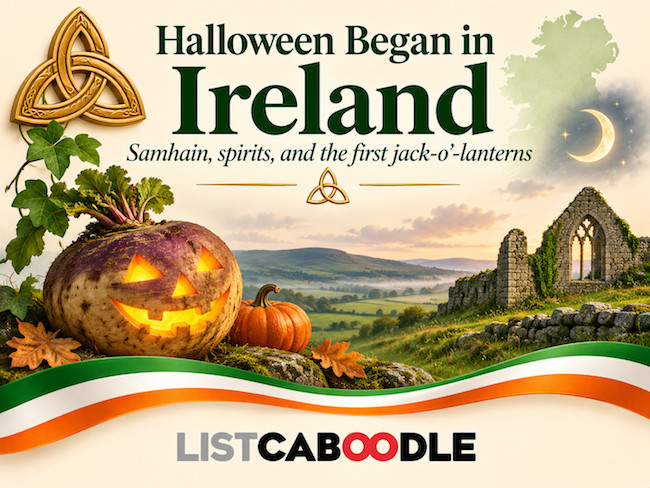
42. The original jack-o’-lanterns were carved from turnips
Before pumpkins became popular in America, Irish people carved frightening faces into turnips and placed lights inside them.
American pumpkins proved considerably easier to carve. This may be one of the most practical improvements Irish emigrants ever made to their customs.
43. St. Patrick wasn’t actually Irish
Ireland’s patron saint was born in Roman Britain. As a teenager, he was captured and taken to Ireland as an enslaved captive.
After escaping, he eventually returned as a Christian missionary. His remarkable story involves courage, faith, and forgiveness.
44. St. Patrick didn’t drive the snakes out of Ireland
According to legend, St. Patrick banished all snakes from Ireland.
Scientists, however, indicate that Ireland never had established populations of native land snakes following the last ice age. Patrick deserves credit for many achievements, but this particular extermination assignment was unnecessary.
45. Ireland has three patron saints
St. Patrick receives most of the international attention, but St. Brigid and St. Columba are also patron saints of Ireland.
St. Brigid is particularly associated with generosity, healing, and the arrival of spring. Her feast day is February 1.
46. Leprechauns weren’t always dressed in green
Early descriptions of leprechauns sometimes featured red clothing. These mischievous supernatural figures were frequently depicted as shoemakers and guardians of hidden treasure.
Modern advertising transformed them into cheerful green-clad ambassadors for everything from breakfast cereal to sports teams.
47. The banshee doesn’t actually kill people
In Irish folklore, the banshee is a supernatural female figure whose haunting cries foretell a death.
Her name comes from the Irish bean sí, meaning fairy woman. Hearing her was traditionally considered a warning rather than the cause of anyone’s demise.
48. Fairy forts are best left undisturbed
Ancient circular earthworks scattered across Ireland are sometimes called fairy forts.
Folklore warns that disturbing these places can bring misfortune. The legends have had a useful side effect: helping protect archaeological sites that might otherwise have been destroyed.
49. Kissing the Blarney Stone supposedly gives you eloquence
Visitors to Blarney Castle in County Cork participate in the centuries-old tradition of kissing its famous stone.
The reward is said to be the gift of persuasive speech. Irish-Americans who already possess this quality may wish to exercise restraint.
50. There are four traditional Celtic seasonal festivals
Imbolc, Bealtaine, Lughnasadh, and Samhain traditionally marked the transitions between seasons.
These celebrations connected agricultural life, spirituality, storytelling, and community gatherings. Their influence remains visible in Irish customs today, particularly around Halloween and St. Brigid’s Day.
Irish Words, Sayings, and Expressions
Even if your great-grandparents left Ireland generations ago, something of their way with words may have traveled with them.
51. Irish is a language, not an accent
The Irish language, known as Ghaeilge, is a Celtic language distinct from English.
It is constitutionally recognized as Ireland’s first official language, with English also recognized as an official language. Although English predominates, Irish remains an important element of national identity.
52. Céad míle fáilte means a hundred thousand welcomes
Pronounced approximately kayd mee-luh fall-chuh, this expression embodies the Irish reputation for hospitality.
One welcome apparently wasn’t considered adequate. Nor, for that matter, were a thousand.
53. Sláinte is the traditional Irish toast
Pronounced roughly as slawn-chuh, the word means “health”.
It’s the Irish equivalent of saying cheers. If you remember only one Irish-language expression before visiting the country, this one has considerable practical application.
Discover dozens of other Irish toasts to celebrate friends, weddings, and more.
54. What’s the craic?
Pronounced crack, craic refers to fun, enjoyable conversation, entertainment, or what’s happening.
If someone asks, What’s the craic?, they’re not requesting information about anything illegal. They’re simply wondering what’s new or whether you’re having a good time.
55. Grand doesn’t necessarily mean magnificent
In Ireland, grand often means fine, acceptable, or perfectly satisfactory.
A person might describe everything from a cup of tea to a minor medical procedure as grand. The Irish have mastered the efficient use of adjectives.
56. Giving out means complaining or scolding
If someone says their mother was giving out to them, it doesn’t mean she was distributing gifts.
She was expressing her dissatisfaction, possibly at considerable length and with supporting historical documentation.
57. Eejit is often a term of affection
A variation of idiot, eejit can express mild annoyance or good-natured affection, depending on the circumstances.
Irish friendship frequently includes a certain amount of verbal abuse. The trick is recognizing whether you’re being insulted or welcomed into the group.
58. Your man doesn’t necessarily belong to you
The Irish frequently use “your man” to refer to another fellow whose name may be unknown, forgotten, or temporarily inconvenient.
Your one, or yer wan, can serve a similar purpose when referring to a woman.
59. The Irish have a proverb for nearly everything
Consider Mol an óige agus tiocfaidh sí — praise the young, and they will flourish.
Another is Ní neart go cur le chéile — there is no strength without unity. Generations of wisdom are neatly packaged in a few words.
60. It’s Paddy, not Patty
Paddy is derived from Pádraig, the Irish form of Patrick.
Consequently, St. Paddy’s Day is a familiar informal expression. St. Patty’s Day, by contrast, tends to cause mild distress among Irish people who otherwise exercise considerable patience with American visitors.
Irish Food, Drink, and Pub Culture
An Irish proverb advises that laughter is brightest where food is best.
By that standard, some Irish kitchens should be positively blinding.
61. Corned beef and cabbage is largely an Irish-American tradition
While Ireland historically produced substantial quantities of corned beef, bacon and cabbage was a more accessible traditional meal for many Irish families.
In America, Irish immigrants embraced corned beef, often purchased from Jewish butchers. A beloved culinary tradition was born through cultural exchange.
62. Potatoes aren’t native to Ireland
Potatoes originated in South America and reached Ireland in the late 16th century.
They eventually became a staple because they produced substantial nourishment from relatively small plots of land. Their introduction profoundly changed Irish agriculture and daily life.
63. Irish soda bread uses an ingenious shortcut
Traditional Irish soda bread relies on baking soda and acidic buttermilk rather than yeast to make it rise.
The basic ingredients are remarkably simple. In the company of good butter and a cup of tea, the result is remarkably difficult to resist.
64. Colcannon is the ultimate Irish comfort food
Colcannon combines mashed potatoes with cabbage or kale, often accompanied by butter and other additions.
It was traditionally associated with Halloween. Some households concealed little objects in the dish as a form of fortune-telling. Dinner came with a prediction.
65. Irish stew was traditionally made with mutton
A classic Irish stew typically features mutton or lamb, potatoes, onions, and sometimes additional vegetables.
Like much traditional Irish cooking, it reflects the ingenuity of households that needed to produce satisfying meals with affordable, readily available ingredients.
66. A full Irish breakfast is a serious undertaking
A traditional full Irish breakfast may include eggs, sausages, bacon, black pudding, white pudding, tomatoes, mushrooms, and bread.
It’s the sort of breakfast that makes lunch seem like an unnecessary administrative detail.
67. Guinness dates back to 1759
Arthur Guinness famously signed a 9,000-year lease for the St. James’s Gate Brewery in Dublin.
Whatever else might be said about his business acumen, he was clearly thinking long-term. His stout became one of the world’s most recognizable Irish products.
68. Irish whiskey has an extra letter
Irish whiskey is generally spelled with an e, whereas Scotch whisky traditionally omits it. And Irish whiskey is also frequently, although not universally, distilled three times. Its production has a long history, and its styles extend well beyond what Americans typically encounter.
69. The Irish are enthusiastic tea drinkers
Guinness might dominate the tourist advertising, but tea occupies a special place in everyday Irish life.
A cup of tea is considered an appropriate response to good news, bad news, unexpected visitors, and practically any situation that requires further discussion.
70. The Irish pub is about more than drinking
Traditional pubs have served as community gathering places, venues for music, informal news exchanges, and centers of storytelling.
You don’t need to drink alcohol to participate. What matters is good company, a comfortable seat, and an appreciation for conversation.
Irish Sports, Literature, and Entertainment
For a relatively small country, Ireland has exported an impressive amount of talent.
71. Hurling is one of the world’s oldest field sports
Players use wooden sticks called hurleys to strike a small ball known as a sliotar.
Combining speed, remarkable hand-eye coordination, and physical courage, hurling is breathtaking to watch. America’s finest baseball players might need a few lessons before attempting it.
72. Gaelic football isn’t soccer
Gaelic football combines kicking, catching, running, hand-passing, and scoring through goalposts.
Unlike American football, play flows continuously without separate offensive and defensive units. It’s fast, physical, and frequently accompanied by passionate commentary from relatives who believe they could manage the team better.
73. The GAA is a cornerstone of Irish community life
Founded in 1884, the Gaelic Athletic Association promotes traditional Irish sports.
Local clubs help connect generations, neighborhoods, and emigrant communities worldwide. At the highest level of Gaelic games, players remain amateur despite attracting enormous crowds and national attention.
74. Ireland’s rugby team represents the whole island
Unlike many international sporting organizations, Ireland’s national rugby teams draw players from both Northern Ireland and the Republic.
This makes rugby an especially interesting example of cooperation across political boundaries. Supporting the team provides common ground for people from different traditions.
75. Ireland has four Nobel Prize winners in literature
W.B. Yeats, George Bernard Shaw, Samuel Beckett, and Seamus Heaney received the Nobel Prize in Literature.
When a country of Ireland’s size produces that many literary giants, it’s reasonable to conclude that the national fascination with words extends beyond pub conversation.
76. Oscar Wilde was an Irishman
Born in Dublin in 1854, Wilde became one of history’s most celebrated wits.
His plays, essays, and novel The Picture of Dorian Gray demonstrated his extraordinary ability to expose social hypocrisy while making audiences laugh.
77. James Joyce has a holiday of his own
Bloomsday, celebrated on June 16, honors Joyce’s groundbreaking novel Ulysses, which takes place on that date in 1904.
Participants dress in period clothing, attend readings, and retrace characters’ journeys through Dublin. It’s a literary pilgrimage with occasional stops for refreshments.
78. Ireland’s contribution to horror literature is considerable
Bram Stoker, the author of Dracula, was born in Dublin. Sheridan Le Fanu, another Irish writer, helped shape Gothic vampire fiction with Carmilla.
Considering Ireland’s associations with Halloween, this literary accomplishment seems particularly appropriate.
79. Riverdance began as an interval performance
In 1994, Riverdance debuted during the Eurovision Song Contest in Dublin.
The performance became an international phenomenon, introducing millions to the athletic precision of Irish dance. Rarely has an audience been so delighted by an intermission.
80. Irish traditional music is alive and well
The fiddle, tin whistle, bodhrán, concertina, and uilleann pipes are characteristic instruments of Irish traditional music.
Attend a good traditional music session, and you’ll discover why cultural traditions don’t necessarily require museums. Sometimes, they simply require a corner of a pub.
Ireland and Its Remarkable American Connections
The Irish didn’t merely arrive in America. They helped shape it, occasionally complaining about the weather in both countries.
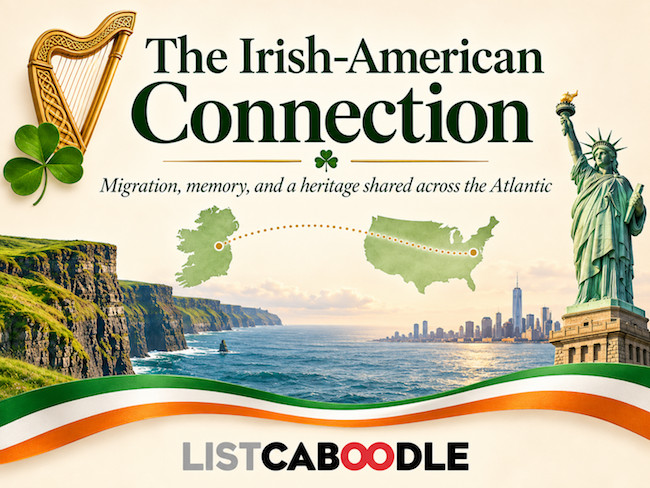
81. There are millions more people of Irish ancestry in America than in Ireland
Approximately 30 million Americans report Irish ancestry, according to recent U.S. Census Bureau estimates.
That’s several times the population of the entire island of Ireland. No wonder St. Patrick’s Day gets such impressive television coverage.
82. Irish immigration wasn’t exclusively Catholic
A significant number of Protestant emigrants from Ulster settled in colonial America, particularly during the 18th century.
Often identified as Scots-Irish or Scotch-Irish, their descendants helped shape American frontier culture, politics, religious life, and musical traditions.
83. The Great Famine accelerated Irish immigration
Families fleeing hunger, poverty, and limited economic opportunities arrived in enormous numbers during the 19th century.
Many settled in cities such as Boston, New York, Philadelphia, and Chicago, establishing communities that preserved Irish cultural traditions while creating new American ones.
84. Coffin ships earned their name
Many famine-era emigrants traveled aboard overcrowded vessels with inadequate sanitation, food, and medical care.
Disease claimed numerous lives during Atlantic crossings. For some Irish-American families, the simple fact that their ancestors survived the journey is itself a remarkable story.
85. Irish immigrants faced considerable discrimination
Irish Catholics encountered prejudice, employment discrimination, and hostility from anti-immigrant political movements.
Over generations, Irish-Americans gained influence through community organizations, education, labor movements, public service, and politics. Their eventual acceptance wasn’t immediate or inevitable.
86. Irish-Americans helped build America’s infrastructure
Irish immigrant laborers worked on American railroads, canals, roads, and other major construction projects.
Many also contributed to the development of American cities through municipal services, businesses, and trade unions. Their legacy is quite literally built into the American landscape.
87. Many American presidents have Irish ancestry
Presidents with Irish or Scots-Irish roots include Andrew Jackson, Ulysses S. Grant, John F. Kennedy, Ronald Reagan, Bill Clinton, Barack Obama, and Joe Biden.
Their backgrounds illustrate the extensive influence of Irish emigration on American political history.
88. John F. Kennedy’s visit to Ireland was deeply emotional
In 1963, President Kennedy visited his ancestral homeland, including County Wexford, where his family has roots.
His reception reflected the affection many Irish people felt for the descendants of emigrants who had left under difficult circumstances and achieved success abroad.
89. Ireland has a special friendship with the Choctaw Nation
In 1847, members of the Choctaw Nation raised money to help Irish famine victims, despite having endured forced displacement and great hardship themselves.
A sculpture of eagle feathers in Midleton, County Cork, commemorates their extraordinary generosity. Ireland has never forgotten the kindness.
90. You might qualify for Irish citizenship
Americans with a grandparent born on the island of Ireland can generally apply for Irish citizenship through the Foreign Births Register.
Different requirements apply to other circumstances. Check Ireland’s official citizenship website before making plans to acquire an Irish passport and move to Galway.
Surprising Things to Know Before Visiting Ireland
91. Ireland isn’t part of Great Britain
Great Britain is the island that includes England, Scotland, and Wales.
The United Kingdom includes those three countries and Northern Ireland. The Republic of Ireland is an independent country and is not part of either.
Getting this right will be greatly appreciated.
92. Ireland uses two currencies
The Republic of Ireland uses the euro. Northern Ireland uses the pound sterling.
A road trip across the island can therefore involve two currencies, two different systems of road measurements, and a surprisingly unobtrusive international border.
93. The Irish drive on the left
Visitors renting cars should remember that traffic drives on the left in both jurisdictions.
The most frightening part of driving in Ireland might not be driving on the left, however. It could be meeting a tractor on a narrow country lane.
94. Irish surnames tell fascinating stories
The prefix O’ traditionally means ‘descendant of’, while Mac or Mc means ‘son of’.
Names such as O’Brien, O’Connor, and MacCarthy connect modern families with Irish history. Researching a surname can open an unexpectedly interesting door into the past.
95. Many traditionally Irish first names aren’t pronounced as Americans expect
Siobhán is pronounced approximately shih-VAWN. Niamh sounds like Neev. Aoife is pronounced EE-fuh, and Caoimhe is commonly pronounced KEE-vuh or KWEE-vuh.
Irish spelling is perfectly logical within its own linguistic system. It simply hasn’t consulted English spelling conventions.
96. The Irish aren’t all redheads
Although red hair is comparatively common in Ireland, most Irish people don’t have it.
Ireland’s population reflects centuries of migration, settlement, and cultural exchange. The popular image of an island populated entirely by redheads belongs mostly to greeting cards and cartoons.
97. Ireland is a modern and increasingly diverse country
Today’s Ireland is home to internationally significant technology companies, pharmaceutical businesses, universities, and creative industries.
It has also experienced substantial social change. The country your ancestors left in the 19th century and the Ireland you’ll visit today are very different places.
98. The Irish sense of humor often involves understatement
Expect dry observations, friendly teasing, self-deprecation, and a particular dislike of people who take themselves too seriously.
Someone describing an exceptionally disastrous event as not ideal may be demonstrating the Irish national talent for understatement.
99. County pride is an important part of Irish identity
Knowing your ancestral county can enrich your experience of visiting Ireland.
Learn its history, explore its villages, attend a local sporting event, and ask about your family name. You may discover that researching your ancestors requires considerably more conversation than paperwork.
100. Being Irish and being Irish-American are different experiences
Irish-Americans have preserved traditions, memories, and cultural practices that developed across generations in a new homeland.
Irish people have experienced different historical and social changes.
Neither identity diminishes the other. They are separate branches of an extraordinary family tree, with more than enough room for both.
The Luck of Being Irish
It’s tempting to summarize Irish history with a few familiar phrases about good fortune, fighting spirit, and the gift of gab.
But anyone who studies Ireland’s history soon realizes that the Irish haven’t always been particularly lucky.
They’ve endured invasions, religious discrimination, famine, forced evictions, political violence, and the heartbreaking experience of watching generations of their children leave home.
And yet, look at what they created.
Great literature. Wonderful music. Thriving communities around the world. Sporting traditions that bring generations together. An extraordinary fondness for storytelling and a remarkable ability to find humor in difficult circumstances.
Sláinte!

By M.L. O’Halloran
Founder and Editor, ListCaboodle
Mike O’Halloran founded ListCaboodle in 2017. He has authored four joke books, three books on basketball coaching, and co-authored four books on kids’ trivia.
His other websites include Sports Feel Good Stories and Greeting Card Poet.
He is the publisher of the Well-Prepared Coach line of coaches’ practice plans, off-season training guides for young athletes, and editable award certificates. The certificate line covers more than 15 sports, including baseball, basketball, football, hockey, golf, softball, tennis, and more.
Mike is married with four children.
You are on our 100 Things Every Irish-American Should Know About Ireland feature.
You might also like:
