
State Capitals Mnemonics
Trying to memorize all 50 state capitals can feel like being asked to remember the names of 50 people you met at a wedding—except nobody is wearing a name tag, and half the people are named Springfield.
You know California. You know Sacramento. But then somebody asks for the capital of Vermont, and suddenly your brain has left the building. Possibly for Montpelier. Possibly for snacks.
The good news? You don’t have to memorize 50 random pairs by sheer force of will. You can give each state and capital a ridiculous little story that makes the answer easier to retrieve. That’s what a mnemonic device does: it connects unfamiliar information to a memorable image, sound, phrase, or association.
Below you’ll find all 50 U.S. states, their correct capitals, and an original memory trick for each one, organized by region. You’ll also get a realistic study plan, a quiz, and advice for remembering the answers longer than the 11 minutes it takes to turn in a geography test.
Ready? Grab an imaginary suitcase. We’re visiting the entire country without a single airport security line.
- What Is a Mnemonic Device, and Why Does It Help?
- Northeast State Capitals: Nine Memory Tricks
- Midwest State Capitals: Twelve Memory Tricks
- Southern State Capitals: Sixteen Memory Tricks
- Western State Capitals: Thirteen Memory Tricks
- The 10 State Capital Mix-Ups to Fix First
- How to Learn the State Capitals in Seven Days
- State Capitals Quiz: Can You Get 20 Without Peeking?
- Four Ways Teachers and Parents Can Make It a Game
- Frequently Asked Questions About Memorizing State Capitals
- Final Thoughts: Geography Is More Fun When It’s a Little Ridiculous
What Is a Mnemonic Device, and Why Does It Help?
A mnemonic (pronounced nih-MON-ik) is a memory aid. You probably already use one: “Every Good Boy Does Fine” for musical notes, “Please Excuse My Dear Aunt Sally” for the order of operations, or a rhyme to remember which months have 30 days.
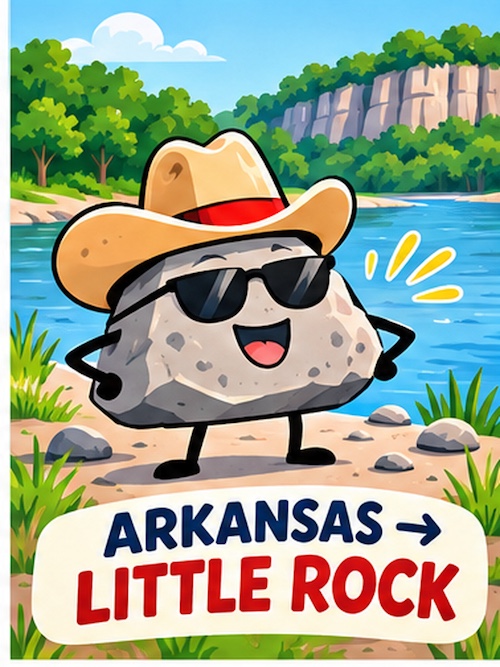
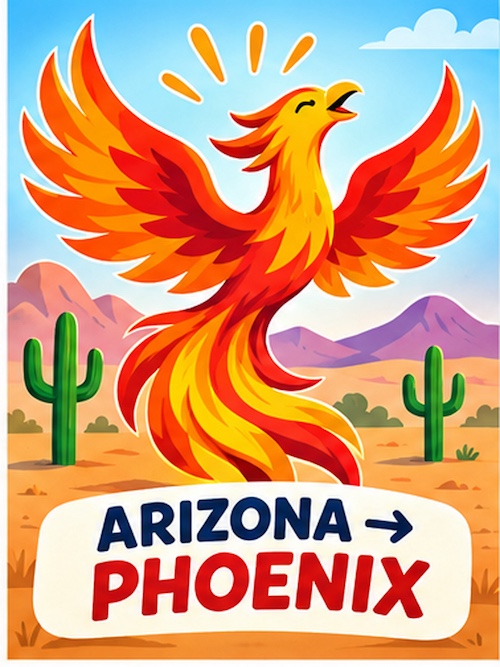
For state capitals, we use visual and sound-based associations. If you picture a fiery phoenix rising above Arizona, Phoenix is a lot easier to pull out of your brain than a word floating by itself. And if a tiny rock wearing cowboy boots is vacationing in Arkansas, Little Rock suddenly has a home.
There’s an important catch: a clever trick is a hook, not a substitute for practice. Research on learning consistently supports retrieval practice—trying to recall an answer before checking it—and spaced practice, which means reviewing on different days instead of cramming once. Use the image to learn the pair, then test yourself without looking. The silliness gets the fact in the door; recall practice helps it stay.
You can read more about those techniques in the science-of-learning review and the Learning Scientists’ study guidance.
Three Rules for a Memory Trick That Actually Works
- Connect both ends. The image must remind you of the state and the capital. A random singing banana is memorable, but unless it sings about Nebraska and Lincoln, it’s not helping.
- Make it weird, but specific. A horse is ordinary. A horse named Frank galloping into a fort in Kentucky is a much better clue for Frankfort.
- Say it, picture it, then cover it. Read the trick, imagine the scene, hide the capital, and answer aloud. If you miss it, try again after a short break.
One more thing: Some tricks are approximate sound-alikes, not spelling lessons. They’re launchpads to the correct name, so always check the printed capital before moving on.
Explore our Fun Geography Trivia for Kids feature.
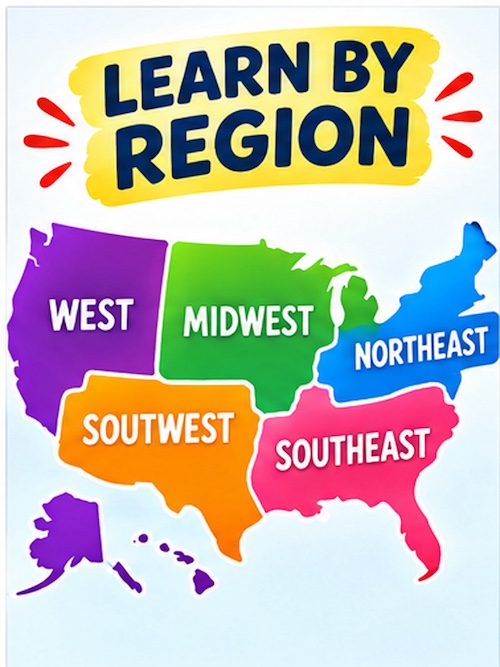
Northeast State Capitals: Nine Memory Tricks
Let’s begin where the states get small, the place names get historical, and a drive through three state borders can take less time than a trip to the grocery store.
- Connecticut — Hartford. Picture a Connecticut mechanic connecting a giant HEART to a FORD car. HEART-FORD leads you to Hartford. The car may never start, but the memory probably will.
- Maine — Augusta. A Maine moose wearing sunglasses declares, “AUGUST-a is my favorite month!” Picture him sunbathing beside a lobster pot.
- Massachusetts — Boston. A Massachusetts BOSS orders a TON of baked beans. BOSS-TON becomes Boston. Somebody should warn the rest of the office.
- New Hampshire — Concord. A new hamster in New Hampshire plugs in a CONcert CORD. CON-CORD. Naturally, the hamster is the lead singer.
- Rhode Island — Providence. A sailor on tiny Rhode Island thanks PROVIDENCE for providing a safe harbor. Think “providence provides protection.”
- Vermont — Montpelier. Vermont’s maple-syrup MONTain spills onto a PELican’s EAR: MONT-PEL-EAR. Close enough to summon Montpelier—then learn its proper spelling.
- New Jersey — Trenton. A New Jersey driver named TRENT turns ON the Turnpike. TRENT-ON sounds like Trenton. The tolls, unfortunately, remain unforgettable.
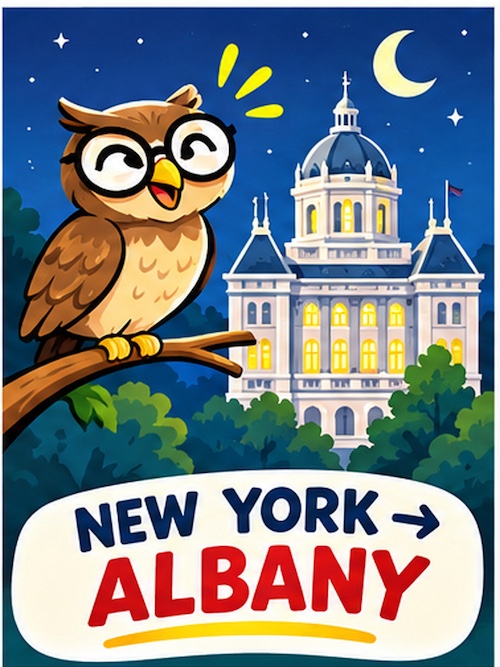
- New York — Albany. An owl named AL sits on a BUNNY outside New York’s statehouse. AL-BUNNY reminds you of Albany—not New York City.
- Pennsylvania — Harrisburg. HARRY’S BURGer stand sits beside Pennsylvania’s capitol. Harry has great fries and a questionable grasp of apostrophes: Harrisburg.
Quick check: Which capital belongs to New York? If you said Albany without peeking, excellent. If you said New York City, imagine Al’s bunny hopping right over Times Square.
Looking for a laugh or two? Check out our funny Geography Jokes for Kids feature.
Midwest State Capitals: Twelve Memory Tricks
Welcome to the Midwest, where cornfields, cheese, and weather forecasts occasionally compete for the lead role. These visual hooks are especially useful because several Midwestern capitals have names that could belong almost anywhere.
- Illinois — Springfield. An Illinois corn stalk SPRINGS across a FIELD like a pogo stick. SPRING-FIELD gives you Springfield, not Chicago.
- Indiana — Indianapolis. An INDY race car circles a bustling city. Picture the Indianapolis 500 and remember that Indianapolis is built right into Indiana’s name.
- Iowa — Des Moines. An Iowa farmer starts his mower and shouts, “DUH, MOYN!” Say it like duh-MOYN, the approximate pronunciation of Des Moines. The silent letters are on vacation.
- Kansas — Topeka. A Kansas tornado scoops up a TOE and a PECK of pickles: TOE-PECK-a. Do not ask where it found the toe.
- Michigan — Lansing. Michigan’s mitten-shaped hand is LANCING a giant balloon with a toy lance. LANS-ing points you to Lansing.
More Midwest Capitals
- Minnesota — St. Paul. A Minnesota hockey player named PAUL wears a saint’s halo over his helmet. SAINT PAUL scores the winning goal. The halo counts as extra padding.
- Missouri — Jefferson City. Thomas JEFFERSON floats down the Missouri River toward a glittering CITY. This one’s almost suspiciously easy: Jefferson City.
- Nebraska — Lincoln. A Nebraska cornfield grows enormous pennies, each stamped with Abraham LINCOLN. It’s harvest time, and every ear is worth one cent.
- North Dakota — Bismarck. A North Dakota bison has a giant BIZ MARK painted on its side. BIZ-MARK leads to Bismarck. Don’t volunteer to repaint the bison.
- Ohio — Columbus. Christopher COLUMBUS pilots a giant Ohio-shaped boat across a lake. “Oh-hi-oh, Columbus!” is your goofy greeting.
- South Dakota — Pierre. A South Dakota prairie dog PEERS over Mount Rushmore. Say “PEER”—roughly how locals pronounce Pierre, rather than the French-sounding “pee-AIR.”
- Wisconsin — Madison. A Wisconsin cow has a MAD SON who ate the entire cheese supply. MAD-SON reminds you of Madison. The cow is understandably furious.
Quick check: Illinois has Springfield, and Missouri has Jefferson City. Now tell that Indiana race car to stay in Indianapolis. Three capitals, one mental traffic jam, and no wrong turns.
Southern State Capitals: Sixteen Memory Tricks
The South brings us giant hats, musical instruments, palmetto trees, and enough imaginary barbecue to make studying dangerous before dinner. Remember, the South here is the broad U.S. Census region, which includes states such as Delaware and Maryland.
- Alabama — Montgomery. An Alabama elephant named MONTY chews GUM all year: MONT-GUM-ERY. Picture a bubble so big it covers the football stadium.
- Arkansas — Little Rock. On an Arkansas riverbank, a LITTLE ROCK puts on cowboy boots and starts giving directions. The simplest images can be the strongest.
- Delaware — Dover. A Delaware DEER leaps OVER the capitol dome. D-OVER sounds like Dover. The deer sticks the landing.
- Florida — Tallahassee. A Florida alligator wears a TALL hat and says, “HA! SEE?” TALL-a-HA-SEE becomes Tallahassee. Formal swampwear is underrated.
- Georgia — Atlanta. A Georgia peach is chased by a gigantic ATLANTIC-sized ANT: ATL-ANT-a. The peach requests protective custody.
- Kentucky — Frankfort. A Kentucky Derby horse named FRANK gallops straight into a FORT. FRANK-FORT. The jockey files a complaint.
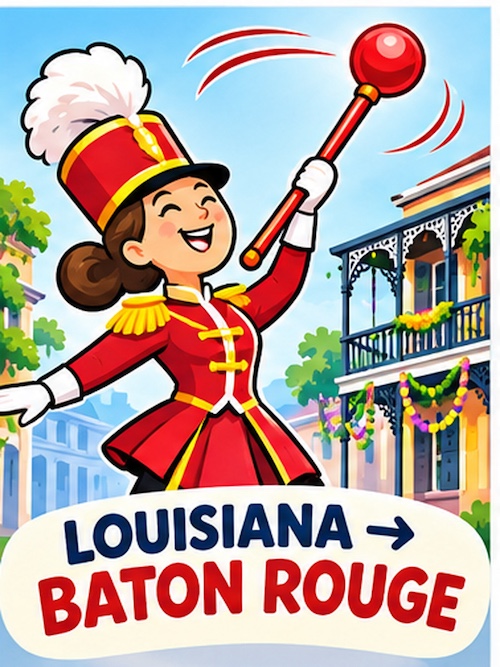
- Louisiana — Baton Rouge. During a Louisiana parade, someone twirls a bright RED BATON. Baton rouge means “red stick/baton” in French. Imagine the whole marching band following it.
Capitals of the South
- Maryland — Annapolis. A Maryland crab named ANNA builds a miniature city, or POLIS, out of sand. ANNA-POLIS: Annapolis. The city council is entirely crabs.
- Mississippi — Jackson. On a Mississippi riverboat, JACK’S SON plays a trumpet. JACK-SON gives you Jackson. Dad insists the solo needs work.
- North Carolina — Raleigh. North Carolina holds a huge RALLY, with everyone chanting “RAH-LEE!” That’s a sound cue for Raleigh.
- Oklahoma — Oklahoma City. One blessed freebie: Oklahoma’s capital is Oklahoma City. Imagine a giant neon sign saying “Welcome to Oklahoma—Yes, Really, That’s the Capital.”
- South Carolina — Columbia. A South Carolina palmetto tree wears a graduation cap from COLUMBIA. Picture a tree giving a commencement speech. Its major? Photosynthesis.
- Tennessee — Nashville. A Tennessee country musician named NASH performs in a tiny VILLAGE: NASH-VILLE. His hit single is “My Tractor Left Me.”
- Texas — Austin. A Texas cowboy says, “AW, STINks!” after stepping into a cow pie. AW-STIN nudges you toward Austin—not Houston or Dallas.
- Virginia — Richmond. A Virginia explorer gets RICH after finding a MOUND of treasure. RICH-MOUND sounds like Richmond. Kindly share with the museum.
- West Virginia — Charleston. In the West Virginia mountains, CHARLIE dances the CHARLESTON on a coal cart. Try to picture the fancy footwork.
Quick check: The two Carolinas don’t share a capital. North Carolina holds a Raleigh rally; South Carolina’s palmetto tree graduates from Columbia. And Virginia’s treasure hunter is nowhere near West Virginia’s Charleston dancer.
Western State Capitals: Thirteen Memory Tricks
Our final region contains beaches, deserts, towering mountains, and one imaginary potato that may soon qualify for a student loan. Several Western capitals sound unlike the states they represent, so give these scenes a few extra seconds.
- Alaska — Juneau. “DO YOU KNOW Alaska’s capital?” “JUNEAU!” The pun sounds like “you know.” It’s terrible. It works for many people.
- Arizona — Phoenix. A giant fiery PHOENIX rises from the Arizona desert, scattering startled cactus wrens. Difficult to forget a bird that doubles as a bonfire.
- California — Sacramento. A California surfer carries a SACK of RAMEN TO the beach: SACK-RA-MEN-TO. The noodles are full of sand, but Sacramento should stick.
- Colorado — Denver. A Colorado bear lives in a ski-slope DEN and wears VERy bright goggles: DEN-VER. Picture him requesting a lift ticket.
- Hawaii — Honolulu. A Hawaiian hula dancer named LULU receives an HONOR: HONOR-LULU leads you to Honolulu. The crowd throws leis instead of confetti.
- Idaho — Boise. An Idaho potato sees a BOY and shouts, “SEE!” BOY-SEE reminds you how Boise is commonly pronounced. Apparently the potato has excellent eyesight.
- Montana — Helena. A Montana mountain climber calls, “HELEN, UH, are you up there?” HELEN-UH becomes Helena. Helen has already reached the summit.
More Capitals of the West
- Nevada — Carson City. In the Nevada desert, a CAR and its SON race through a miniature CITY. CAR-SON CITY. The family resemblance is striking.
- New Mexico — Santa Fe. SANTA visits New Mexico wearing a giant FEathered hat. SANTA-FE. The reindeer are confused by the weather.
- Oregon — Salem. An Oregon Trail wagon tries to SAIL ‘EM across a river: SAIL-EM sounds like Salem. The horses are not enthusiastic sailors.
- Utah — Salt Lake City. Think of Utah’s Great SALT LAKE, then put a CITY beside it. Salt Lake City. The geographic clue does the heavy lifting.
- Washington — Olympia. A Washington mountain climber wins an OLYMPIC medal at the statehouse. OLYMPIA—not Seattle, and definitely not Washington, D.C.
- Wyoming — Cheyenne. A Wyoming cowboy calls to a horse named SHY ANN. SHY-ANN reminds you of Cheyenne. Ann is shy until somebody brings carrots.
You made it: Fifty states, fifty capitals, and an alarming number of imaginary animals with jobs. Now comes the part that turns those scenes into actual knowledge: using them without looking at the page.
The 10 State Capital Mix-Ups to Fix First
One of the biggest pitfalls is assuming the state’s most famous or largest city must be the capital. Sometimes it is. Frequently, it’s not. Your geography teacher has been waiting for this moment all semester.
- New York: Albany, not New York City. Think AL-BUNNY.
- California: Sacramento, not Los Angeles or San Francisco. Bring the sack of ramen.
- Illinois: Springfield, not Chicago. Watch the spring-loaded corn stalk.
- Florida: Tallahassee, not Miami or Orlando. Tall-hatted alligator.
- Nevada: Carson City, not Las Vegas. Car plus son.
- Washington: Olympia, not Seattle. Olympic medal at the capitol.
- Texas: Austin, not Houston or Dallas. AW-STINk!
- Pennsylvania: Harrisburg, not Philadelphia or Pittsburgh. Harry’s burger stand.
- Michigan: Lansing, not Detroit. The mitten hand with a lance.
- Maryland: Annapolis, not Baltimore. Anna the crab builds a city.
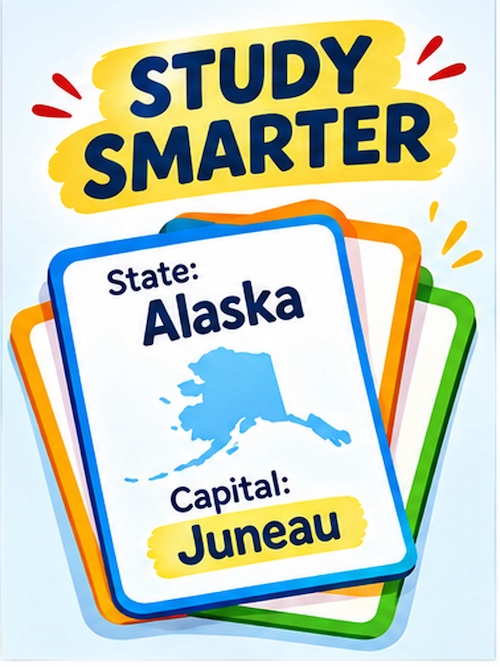
Here’s a useful habit: Write the wrong guess on one side of a card and the correct capital on the other. When you think “Chicago,” deliberately respond “Illinois—Springfield.” That correction is a practice opportunity, not evidence you’re bad at geography.
How to Learn the State Capitals in Seven Days
Can you learn 50 pairs in a week? Many learners can make substantial progress with short, focused sessions, though the amount of time varies by age, familiarity, and practice. Don’t let the calendar bully you. Aim for 10–15 minutes a day, then continue reviewing until the answers are comfortable.
- Day 1 — Northeast: Study nine pairs. Say each capital aloud, close the list, and try again in mixed order.
- Day 2 — Midwest: Learn 12 new pairs. Begin by retrieving yesterday’s nine, without peeking.
- Day 3 — South, part one: Learn Alabama through Maryland. Test yourself on a handful from the first two regions.
- Day 4 — South, part two: Finish Mississippi through West Virginia. Quiz all 16 Southern states.
- Day 5 — West: Learn the 13 Western pairs. Draw or label a rough regional map if that helps.
- Day 6 — The troublemakers: Shuffle all 50. Put every missed state in a small “not yet” pile and drill that pile more often.
- Day 7 — The championship: Take a 50-state test in random order, then reverse it: hear the capital and name the state.
Don’t study only in alphabetical order. Alphabetical lists can turn into a sing-song performance that collapses the moment somebody asks a random question. Practice in reverse order, by region, and with shuffled cards.
For longer-lasting results, revisit the deck a few days later, then again the following week. The secret isn’t staring harder. It’s successfully remembering at intervals.
State Capitals Quiz: Can You Get 20 Without Peeking?
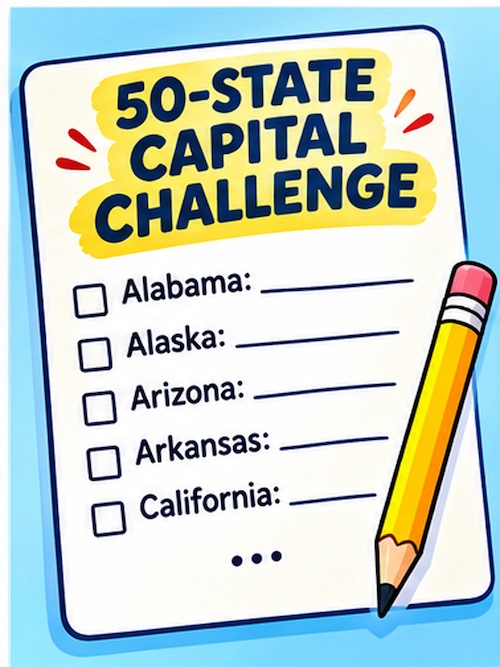
Cover the earlier sections or hand your phone to a friend. Write the capital beside each state. The questions deliberately jump between regions, because real conversations don’t arrive in alphabetical order.
- Vermont: __________
- Kentucky: __________
- Washington: __________
- North Dakota: __________
- Rhode Island: __________
- Arizona: __________
- Missouri: __________
- New York: __________
- Arkansas: __________
- Oregon: __________
- Minnesota: __________
- Delaware: __________
- South Carolina: __________
- Nevada: __________
- Connecticut: __________
- Wisconsin: __________
- Idaho: __________
- Florida: __________
- Nebraska: __________
- Wyoming: __________
Quiz Answer Key
Montpelier; Frankfort; Olympia; Bismarck; Providence; Phoenix; Jefferson City; Albany; Little Rock; Salem; St. Paul; Dover; Columbia; Carson City; Hartford; Madison; Boise; Tallahassee; Lincoln; Cheyenne.
Score yourself: 18–20: Statehouse superstar. 14–17: Geography road warrior. 10–13: Promising tourist. Fewer than 10: Your imaginary moose, owl, and potato have more work to do. No shame—review the missed pairs and try a different order tomorrow.
Four Ways Teachers and Parents Can Make It a Game
Memory-picture challenge: Give each learner three tricky pairs and have them draw one absurd picture per pair. No artistic talent required. A lopsided moose shouting “Augusta!” earns full credit.
Capital relay: Divide players into teams. Call out a state; the first player writes its capital on the board. Rotate players so nobody gets stuck doing all the geography while everybody else enjoys the snacks.
Reverse geography: Say “Cheyenne,” “Pierre,” or “Annapolis,” and ask for the state. Reversing the clue checks whether students know the pair, not merely a memorized sequence.
Family road-trip game: Whenever a license plate appears, call out that state’s capital. It’s a surprisingly productive way to pass miles—provided the driver keeps eyes on the road and leaves the shouting to passengers.
Frequently Asked Questions About Memorizing State Capitals
What is the easiest way to memorize all 50 state capitals?
Start with a few state-capital pairs at a time, ideally in regional groups. Create a strong visual or sound-based mnemonic for each pair, then hide the answer and retrieve it from memory. Mix up the order and repeat over several days. Simply rereading the list is less useful than checking whether you can answer.
Should kids memorize state capitals alphabetically or by region?
Regions make an excellent starting point because they connect the names to locations on a map. Alphabetical order can be handy for checking that no state was missed. But the final test should be shuffled so students can answer “What’s the capital of Idaho?” without mentally reciting everything from Alabama onward.
Is Washington, D.C., one of the 50 state capitals?
No. Washington, D.C., is the capital of the United States, not the capital of a state. The capital of Washington state is Olympia. That’s one distinction worth memorizing before somebody turns it into a trick question.
Which state capitals are especially easy to confuse?
Albany/New York, Springfield/Illinois, Carson City/Nevada, Harrisburg/Pennsylvania, and Olympia/Washington catch many learners who automatically think of a more famous city. Our ten-item mix-up list above is a useful place to begin practicing.
Do silly mnemonic devices really help adults?
They can. Adults can use distinctive images and word associations just as children can. Not every mnemonic will click for every learner, though. The best trick is the one you can immediately picture and use to retrieve the right answer. If ours doesn’t stick, invent a stranger one.
How can I tell whether I’ve actually learned the capitals?
Answer the state-to-capital question without hints, in a random order, and check the result. Then try capital-to-state questions and a blank map. Return after a few days. Recognizing an answer when you read it is not the same as retrieving it independently.
Final Thoughts: Geography Is More Fun When It’s a Little Ridiculous
You don’t need a photographic memory to learn all 50 state capitals. You need a handful of memorable connections, some low-pressure practice, and the willingness to picture a Wisconsin cow furious at her cheese-stealing son.
Use these mnemonics as a starting point. Adjust the ones that don’t click. Draw the most ridiculous scenes. Test yourself before checking the answers. Then test yourself again next week.
Before long, “What’s the capital of Vermont?” won’t produce awkward silence. It will produce a maple-covered pelican and a confident answer: Montpelier.
And really, isn’t that what education is all about? Well, that and learning not to spell it “Vermount.”
Sources and Further Reading
- Ballotpedia: List of capitals in the United States
- The Learning Scientists: Study strategy FAQ
- Teaching the Science of Learning (research review)

By M.L. O’Halloran
Founder and Editor, ListCaboodle
Mike O’Halloran founded ListCaboodle in 2017. He has authored four joke books, three books on basketball coaching, and co-authored four books on kids’ trivia.
His other websites include Sports Feel Good Stories and Greeting Card Poet.
He is the publisher of the Well-Prepared Coach line of coaches’ practice plans, off-season training guides for young athletes, and editable award certificates. The certificate line covers more than 15 sports, including baseball, basketball, football, hockey, golf, softball, tennis, and more.
Mike is married with four children.
You are on our Memorize All 50 U.S. State Capitals: Easy Mnemonic Tricks feature.
You might also like:
